
Loading…

India Cricket Team Coaches List (1971-2026)
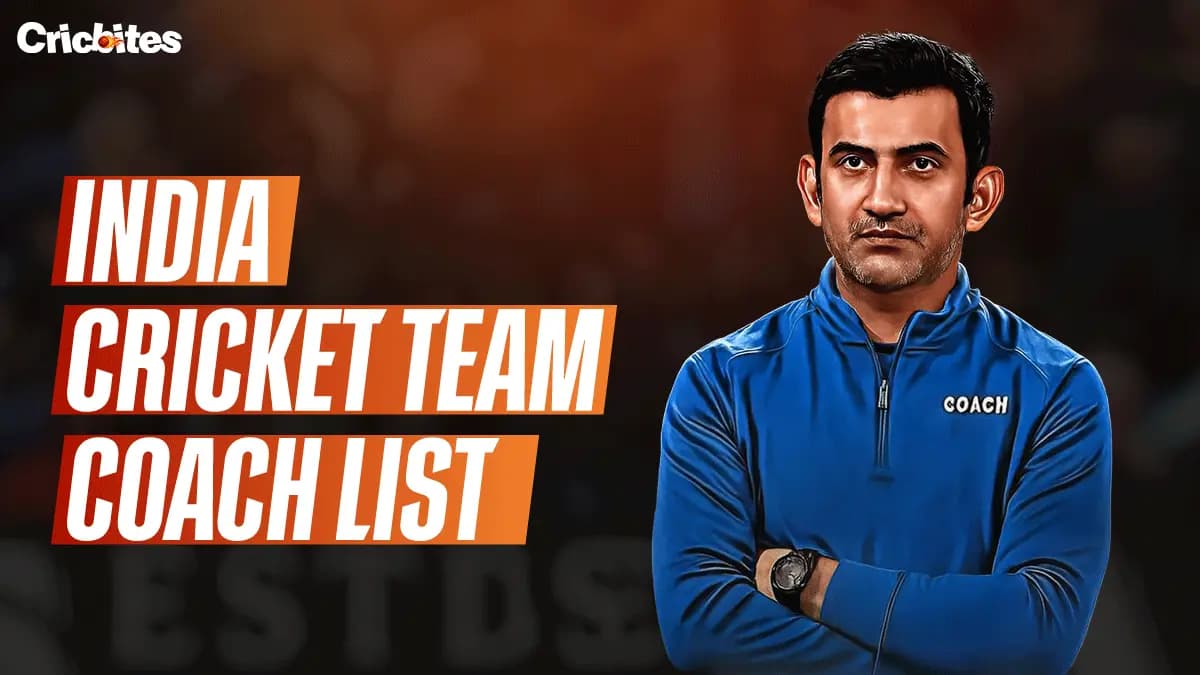
The Indian cricket team is one of the most prestigious teams in the world. We admire the players, their talent, thrilling performances, and historic victories. But behind every victory is a coach who strategizes, studies opponents, and shapes the team’s identity. From 1971 to 2025, India has had numerous coaches, outstanding domestic players, and international experts. Each has contributed in their own way and influenced the journey of Indian cricket.
The following blog presents the complete list of coaches of the Indian men’s and women’s cricket teams from 1971 to 2025.
List of Head Coaches of Indian Men’s Cricket Team (1971-2025)
Below is a clean, easy-to-read table:
| Coach Name | Years as Coach | Key Highlights |
|---|---|---|
| Raj Singh Dungarpur | 1971–1974 | Helped young players improve |
| Hemu Adhikari | 1979–1980 | Focused on team unity |
| Bishen Singh Bedi | 1990–1991 | Improved bowling discipline |
| Abbas Ali Baig | 1991–1992 | Focused on youth development |
| Ajit Wadekar | 1992–1996 | Strong home series wins |
| Madan Lal | 1996–1997 | Strengthened all-round performance |
| Anshuman Gaekwad | 1997–1999, 2000 | Built team unity and discipline |
| Kapil Dev | 1999–2000 | Tried energizing team culture |
| John Wright | 2000–2005 | Reached 2003 World Cup Final |
| Greg Chappell | 2005–2007 | Introduced young talent |
| Lalchand Rajput | 2007 | Won T20 World Cup 2007 |
| Gary Kirsten | 2008–2011 | Won 2011 World Cup |
| Duncan Fletcher | 2011–2015 | Won 2013 Champions Trophy |
| Ravi Shastri | 2014–2016, 2017–2021 | Won Test series in Australia |
| Anil Kumble | 2016–2017 | Dominant home performances |
| Rahul Dravid | 2021–2024 | Won 2024 T20 World Cup |
| Gautam Gambhir | 2024–Present | Early tenure, results upcoming |
List of Head Coaches of India Women’s Cricket Team (2003-2025)
| Coach Name | Years | Nationality |
|---|---|---|
| Sudha Shah | 2003–2007 | India |
| Shantha Rangaswamy | 2003–2007 | India |
| Sudha Shah | 2008–2010 | India |
| K.V.P. Rao | 2010 | India |
| Anju Jain | 2011–2013 | India |
| Tushar Arothe | 2013–2014 | India |
| Purnima Rau | 2014 | India |
| Sudha Shah | 2014 | India |
| Purnima Rau | 2015–2017 | India |
| Tushar Arothe | 2017–2018 | India |
| Ramesh Powar | 2018 | India |
| WV Raman | 2018–2021 | India |
| Ramesh Powar | 2021–2022 | India |
| Amol Muzumdar | 2023–present | India |
Overview: Coaches of the Indian Cricket Team, 1971-2025
Below is a ‘readable’ detailed description of each coach from 1971 through the 2025 season.
1. Raj Singh Dungarpur (1971-1974)
Raj Singh Dungarpur was one of India’s earliest head coaches, working at the grassroots level. This was at a time when Indian cricket lacked formal coaching structures. He worked with young players and honed their basic skills. His tenure ended in 1974 when he took on administrative roles within the BCCI.
2. Hemu Adhikari (1979-1980)
Former Indian batsman Hemu Adhikari coached the national team for a year. He emphasized discipline, teamwork, and fitness—all new concepts in Indian cricket at the time.
3. Bishen Singh Bedi (1990-1991)
Meanwhile, legendary spinner Bishan Singh Bedi focused on strengthening the Indian bowling attack. His coaching was sharp, honest, and disciplined. He captained the team for a short time before stepping down.
4. Abbas Ali Baig (1991-1992)
Baig helped India focus on young talent. His contributions helped nurture the players of the early 90s, although his tenure only lasted a year.
5. Ajit Wadekar (1992-1996)
Under Wadekar’s leadership, India dominated the home team. His calm leadership instilled confidence in the players. However, after India’s poor performance in the 1996 World Cup, he resigned.
6. Madan Lal (1996-1997)
World Cup-winning all-rounder Madan Lal worked to improve India’s overall game. His tenure lasted only a year, but his emphasis on all-round development was praised.
7. Anshuman Gaekwad (1997-1999, 2000)
Gaekwad was a two-time coach. He was respected for his calm demeanor and team management skills. He helped build unity among the players, especially during difficult overseas tours.
8. Kapil Dev (1999-2000)
India’s 1983 World Cup hero Kapil stayed with the team for a year, where he focused on aggression and discipline, but resigned after the match-fixing controversy.
9. John Wright (2000-2005)
India’s first foreign coach changed Indian cricket forever. Bottom right:
- ✔ India’s victories abroad
- Reached the final of the 2003 World Cup
- Defeated Australia in the prestigious 2001 Test series
- He laid the foundation for the team’s success today.
10. Greg Chappell (2005-007)
Greg Chappell’s primary focus was on fostering young talent and modern training techniques. However, his tenure was fraught with controversy and internal disagreements. An early exit from the 2007 World Cup led to his resignation.
11. Lalchand Rajput (2007)
Rajput was India’s manager/head coach in the inaugural T20 World Cup. His captaincy ushered in a new era in cricket when India won the inaugural T20 World Cup in 2007.
12. Gary Kirsten (2008-2011)
Undoubtedly, he is one of the best coaches India has ever had.
Under Kirsten’s leadership:
- India won the 2011 Cricket World Cup
- Achieved the No. 1 ranking in Test cricket
- Subsequently, MS Dhoni became a great captain.
- Players praised his calm demeanor and player-first approach.
13. Duncan Fletcher (2011-2015)
Fletcher helped transform the Indian team after the retirements of Tendulkar, Dravid, and Laxman.
His achievements include:
- Winning the 2013 Champions Trophy
- Building a new core of players
14. Ravi Shastri (2014-2016, 2017-2021)
The coach is courageous, aggressive, and inspiring.
Under Shastri’s leadership:
- ✔ India won two consecutive Test series in Australia.
- ✔ Developed a dominant Test team.
- ✔ Reached the knockout stages of several ICC tournaments.
15. Anil Kumble (2016-2017)
Known for his discipline and strategy.
During Kumble’s tenure:
- ✔ India dominated home Test series
- ✔ Several world-class bowlers were developed
- According to reports, differences with the players led to the end of his tenure.
16. Rahul Dravid (2021-2024)
Under Dravid’s leadership:
- ????India reached the final of the 2023 ODI World Cup
- Won the 2024 T20 World Cup
- Nurtured young players like Gill, Ishan, Jaiswal, and Ruturaj.
- A calm, methodical, and development-focused coach.
17. Gautam Gambhir (2024-Present)
Gautam Gambhir is currently the head coach until 2025.
Known for:
- Aggression
- Tactical excellence
- Supporting young talent
- His tenure has just begun, but expectations are high.
Read More: List of Presidents of BCCI (Board of Control for Cricket in India)
Big Wins Under Various Coaches
Indian coaches have led the team to many big wins and proud moments:
World Cup triumphs: In 2011, under the leadership of Gary Kirsten, India won the ODI World Cup after 28 years. In 2007, under the coach of Lalchand Rajput, India won the first T20 World Cup. In 2024, India won the T20 World Cup under the leadership of Rahul Dravid.
Test cricket success: Under the leadership of Ravi Shastri in 2018-19, India won its first Test series in Australia. John Wright helped India draw a Test series in Australia in 2003-04, which is a big achievement.
Other big wins: Under the coach of Duncan Fletcher, India won the 2013 Champions Trophy. Under the leadership of Rahul Dravid, India started winning more matches in all formats of cricket.
Big Problems That Coaches Need to Solve
Indian cricket coaches face many difficult situations:
Injuries and poor form: Players often get injured or do not play well. Coaches find new players and help struggling players improve their game.
Internal fights in the team and external pressure: Sometimes players argue with each other. Coaches resolve these issues and keep the team together. They also deal with pressure from fans and the media.
Different formats of cricket: Coaches guide players to adjust between Test, ODI and T20 matches. They make plans for different countries and playing conditions.
Changing cricket style: Cricket keeps changing with time. Coaches learn new training methods and use technology and data to help the team perform better.
These challenges and achievements show how important coaches are to the Indian team. They help the team win matches and also manage problems off the field to keep the team strong.
Conclusion
From 1971 to 2025, Indian cricket has undergone tremendous changes—and coaches have played a crucial role in shaping this progress. Whether it was Gary Kirsten’s calm demeanor or Rahul Dravid’s discipline, each coach brought their own unique style and direction. Fans are excited about the dawn of a new, fearless era in Indian cricket under Gautam Gambhir.
FAQs: Questions & Answers
Q1. Who was the first head coach of the Indian men’s cricket team?
Raj Singh Dungarpur is considered one of the earliest official coaches of India from 1971 to 1974. Before the 70s, India did not have a formal coaching system.
Q2. Who was the coach of India in 2007 T20 World Cup?
Lalchand Rajput was the manager/head coach during India’s victory in the inaugural T20 World Cup under MS Dhoni.
Q3. Who is the Indian cricket team coach at present in 2025?
Gautam Gambhir is the head coach of the Indian men’s team (2024-present).
Q4. Who was India’s first foreign coach?
India’s first foreign head coach in 2000 was John Wright (New Zealand).
Q5. Who was India’s coach in the 2011 World Cup?
Gary Kirsten led India to a historic ICC World Cup victory in 2011.