

Loading…

Mona Meshram Debut, Stats, Age, Net Worth, Records, Bio & ICC Ranking
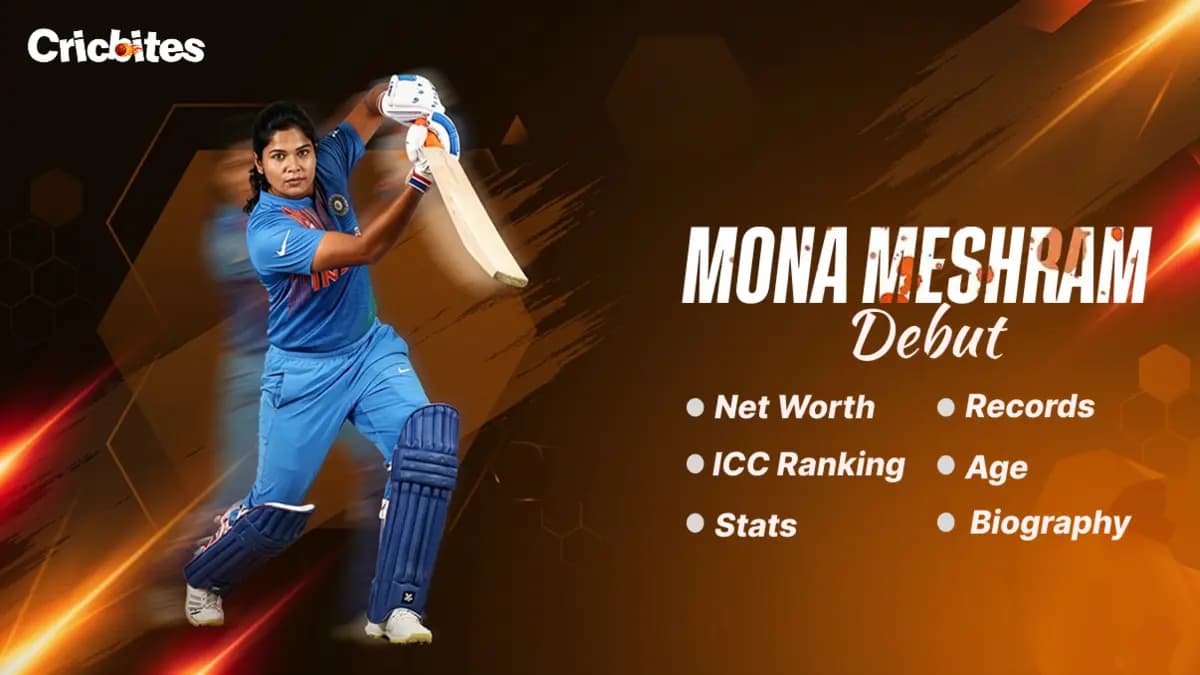
Mona Meshram was born on 30 September 1991 in Nagpur, Maharashtra. She is now thirty-four years old. She is a right-handed batsman and bowls right-arm medium pace. She played One Day Internationals and Twenty20 Internationals for the Indian women’s team from 2012 to 2019. She played twenty-six ODIs and eleven T20 Internationals for India. She was part of the team that reached the final of the 2017 Women’s Cricket World Cup at Lord’s. The final was watched by millions and India lost, but reaching the final was a significant achievement.
Her career has been about surviving in a system where opportunities are rare and competition is fierce. She has played domestic cricket for Vidarbha Women, Railways Women, India Blue Women and Supernovas. She has scored three ODI half-centuries, with her highest score being an unbeaten 78. These runs came when she was given opportunities, but such opportunities did not come often. This is the reality for many cricketers who are good but not exceptional.
Early Life and Biography
Nagpur is a city in central India known for its oranges and cricket. The Vidarbha Cricket Association Stadium hosts international matches. Meshram grew up in this cricket-centric environment. We do not have much information about her family or how she started playing cricket. She keeps these details private, or they have not been publicly documented.
All we know is that in her late teens, she started playing cricket seriously. Nagpur and the Vidarbha region have produced many cricketers. The infrastructure was available. Coaching was available. Talented young players could progress from age-group cricket to the state teams.
Meshram developed into a right-handed batsman who could build innings with controlled technique. She also bowled an effective right-arm medium pace, which was sometimes used when teams needed an extra bowling option. This dual ability made her valuable in team selection. A batsman who can bowl a few overs when needed provides tactical flexibility.
In the early 2010s, she was playing domestic cricket for Vidarbha. Later, she played for Railway Women, one of the strongest domestic teams, which also provided employment alongside cricket. The exact year of her domestic debut is not widely published, but by 2012, when she received an international call-up, she had established herself in domestic cricket.
Domestic and International Debut
Meshram made her international debut on 24 June 2012 in an ODI against the Ireland women’s team. Two days later, on 26 June 2012, she played her first T20I against the England women’s team. She was twenty years old. This debut came after impressive performances in senior domestic cricket and the Challenger Trophy, where the selectors recognised her as a reliable batsman and part-time bowler.
Her early international runs cemented her place in India’s middle order. The transition from domestic cricket to international cricket is challenging. The bowling is faster and more accurate. The fielding is sharper. Mistakes are punished immediately. Meshram gradually adapted, learning what worked and what didn’t at that level.
In domestic cricket, she continued to represent Vidarbha and Railways. She also played for the India Blue women’s team in zonal competitions and for Supernova in invitational tournaments.
Biography Details
| Full Name | Mona Rajesh Meshram |
|---|---|
| Date of Birth | 30 September 1991 |
| Age (2026) | 34 years |
| Birthplace | Nagpur, Maharashtra, India |
| Nationality | Indian |
| Role | Batter |
| Batting Style | Right-handed bat |
| Bowling Style | Right-arm medium |
| Domestic Team | Vidarbha Women, Railways Women, India Blue Women, Supernovas |
| International Team | India Women |
| Marital Status | Not publicly documented (no reliable source confirming) |
| Spouse | Not publicly documented (no verified information found) |
| Net Worth | Not officially disclosed (no credible public estimate available) |
Career Batting Stats
| Format | Year Span | Matches | Innings | Not Outs | Runs | High Score | Average | Balls Faced | Strike Rate | 100s | 50s | 4s | 6s |
|---|---|---|---|---|---|---|---|---|---|---|---|---|---|
| ODI | 2012–2019 | 26 | 26 | 2 | 352 | 78* | 18.5 | 655 | 53.7 | 0 | 3 | 38 | 4 |
| T20I | 2012–2018 | 11 | 11 | 2 | 125 | 32 | 17.9 | 159 | 78.6 | 0 | 0 | 8 | 0 |
Career Bowling Stats
| Format | Year Span | Matches | Innings | Balls Bowled | Maidens | Runs Given | Wickets | Best Bowling | Economy | Average | Strike Rate | 4W | 5W |
|---|---|---|---|---|---|---|---|---|---|---|---|---|---|
| ODI | 2012–2019 | 26 | 8 | 144 | 0 | 119 | 1 | 1/15 | 4.96 | 119.0 | 144.0 | 0 | 0 |
| T20I | 2012–2018 | 11 | 5 | 72 | 0 | 50 | 1 | 1/9 | 4.17 | 50.0 | 72.0 | 0 | 0 |
Career Fielding Stats
| Format | Year Span | Catches | Run Outs | Stumpings |
|---|---|---|---|---|
| ODI | 2012–2019 | 10 | 5 | 0 |
| T20I | 2012–2018 | 2 | 2 | 0 |
Career
Mona Meshram’s international career spanned seven years from 2012 to 2019, but she rarely played. Playing just 26 ODIs and 11 T20Is in seven years meant that her place in the team was not secure. Competition for batting positions in Indian women’s cricket was fierce.
Established players held their ground, and new talent kept emerging. Consistent opportunities were hard to come by.
She scored three ODI half-centuries. Her highest score was an unbeaten 78. That innings showed what she was capable of when the opportunity came and when everything clicked.
An unbeaten 78 in ODI cricket requires technique, concentration and the ability to turn the strike and hit boundaries at the right time. She had these skills.
The highlight of her international career was being part of the Indian team for the 2017 Women’s Cricket World Cup. The tournament was held in England. India reached the final at Lord’s. They played England in a packed stadium and lost by nine runs. It was heartbreaking, but historic. Being part of that team meant being part of a team that took Indian women’s cricket to a new level of recognition and respect.
After 2017, her international opportunities dwindled. Team combinations changed. New players emerged. She last played an international match in 2019. She was twenty-seven. Many cricketers have long careers, but the system is very demanding. When opportunities stop coming, you either accept them or you don’t. Meshram continued to play domestic cricket.
WPL Career and Teams
Mona Meshram has no verified record of playing in the Women’s Premier League. She was thirty-one when the WPL started in 2023. The league prioritized young players and established international stars. Her last international match was four years ago. Franchise leagues take into account current form and future potential. She did not meet these criteria.
This is normal. Many local cricketers who played before the franchise league started do not get the benefits of this league. The timing is not right. Their careers are at their peak at a time when financial opportunities are not available. Yet they continue to play because they love the game.
Playing Style and Strengths
Meshram was a right-handed top-order or middle-order batsman. She played her innings with a balance of patience and aggression. Her technique was controlled. When needed, she could anchor the innings by playing defensively and collecting runs by rotating the strike. When the situation demanded, she could also score quickly, hit boundaries and convert a good start into a big score.
Her right-arm medium-pace bowling was an occasional option. The captain used it when a change of pace was needed or when the regular bowlers needed a rest. It was not her primary skill; teams preferred her to bat. However, the bowling option added to her value.
Her fielding was good. She had a good understanding of the game on the field, positioned herself well and took clean catches whenever opportunities arose.
Read More: Sophie Devine Debut, Stats, Age, Net Worth, Records, Bio & ICC Ranking
Records and Achievements
Mona Meshram represented India in twenty-six ODIs and eleven T20Is from 2012 to 2019. She scored three ODI half-centuries, with her highest score being an unbeaten 78. She was part of the Indian team that reached the final of the 2017 Women’s Cricket World Cup at Lord’s.
This is an official record. It does not include the hard work she put in to reach international cricket from Nagpur. It does not include years of domestic cricket or matches played without recognition. It does not include her continued dedication to the game even after her international opportunities ended.
Net Worth and Earnings
Mona Meshram’s net worth has not been officially disclosed. No reliable public estimates are available. Her income is likely to come from domestic cricket contracts, match fees and possible payments for invitation leagues. Exact figures have not been published.
Before the WPL and the BCCI’s significant contracts for women cricketers, earnings from cricket alone were common. Many players relied on employment in organisations like the railways or state governments. The salary from such employment enabled them to pursue cricket professionally.
Marriage and Personal Life
Details about Mona Meshram’s marriage or partner are not publicly confirmed by reliable cricket sources. She keeps her personal life private. This is her choice and should be respected. What matters is what she did on the cricket field and what she contributed to the teams she represented.
Conclusion
Mona Meshram’s career tells a familiar story in Indian women’s cricket. She came from a cricket playing background. She worked her way up through domestic cricket. She earned international selection. She played limited overs for seven years. She was part of a historic World Cup final. Then the opportunities ran out and she continued to play domestic cricket.
Not a great career by international standards, but remarkable by any reasonable standard. She represented her country. She scored runs at international level. She contributed to teams that achieved remarkable things. She continued to play when fame and selection moved elsewhere.
Now at thirty-four she carries the experience of that journey with her. Whether she continues to play, or goes into coaching, or walks away from cricket altogether, what she did remains the same. She played the game at the highest level and she played it with competence and determination. That is achievement enough.