
Loading…

Lists Of Player Of The Match Award Winners In ICC T20 WC History
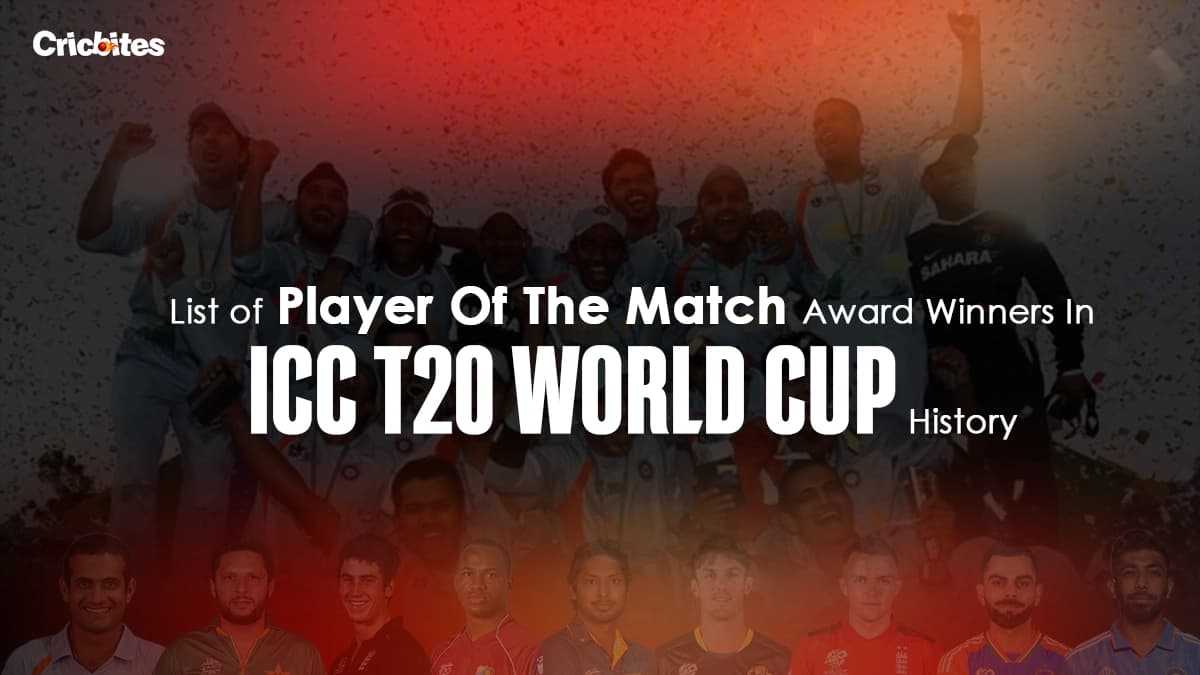
The T20 World Cup final is a short game with little room for error. One performance can turn the tide of a match. The Player of the Match is the man who delivers that moment. He makes the consistent runs that chase, takes the wickets that break the batting order, or makes the fielding play that closes out the contest. The list below records those performances. It captures the statistics and moments that decided the world title.
Player of the Match Winners in ICC Men’s T20 World Cup Finals
| S.No | Player | Team | Year |
|---|---|---|---|
| 1 | Irfan Pathan | India | 2007 |
| 2 | Shahid Afridi | Pakistan | 2009 |
| 3 | Craig Kieswetter | England | 2010 |
| 4 | Marlon Samuels | West Indies | 2012 |
| 5 | Kumar Sangakkara | Sri Lanka | 2014 |
| 6 | Marlon Samuels | West Indies | 2016 |
| 7 | Mitchell Marsh | Australia | 2021 |
| 8 | Sam Curran | England | 2022 |
| 9 | Virat Kohli | India | 2024 |
| 10 | Jasprit Bumrah | India | 2026 |
1. Irfan Pathan (ICC Men’s T20 World Cup 2007)
In the 2007 final, Pathan bowled with a clear plan. He took three wickets for sixteen runs in four overs. His wickets were taken by Pakistan’s key batsmen. He fell when Pakistan was chasing. India had set a target of 157 for 5. Pakistan lost by five runs, scoring 152 for 10. Pathan’s magic broke the chase and he won the award.
2. Shahid Afridi (ICC Men’s T20 World Cup 2009)
Afridi was needed with both bat and ball in the final. He scored an unbeaten fifty-four off forty balls. He also bowled four overs and took one wicket for twenty runs. Sri Lanka scored 138 for 6. Pakistan chased down the target and scored 139 for 2 in 18.4 overs. Afridi guided the chase with a calm bat and helped control the innings with the ball. His all-round work helped Pakistan reach the title.
Read More: Most Player of The Match Awards in T20Is (Top 15 List)
3. Craig Kieswetter (ICC Men’s T20 World Cup 2010)
In the final, Kieswetter opened the batting for England. He scored 63 runs off forty-nine balls. Australia had set a target of 147 runs for the loss of 6 wickets. England chased down the target with control and scored 148 runs for the loss of 3 wickets in seventeen overs. Kieswetter’s innings gave England a strong start. He attacked the bowlers and kept the runs flowing. His innings laid the foundation for England’s first T20 World Cup title.
4. Marlon Samuels (ICC Men’s T20 World Cup 2012)
Samuels played a balanced final for West Indies. He scored fifty-eight runs in fifty-six balls. He also bowled four overs and took one wicket for fifteen runs. West Indies scored 137 for six. Sri Lanka were all out for 101. The match was won by thirty-six runs. Samuels strengthened the innings with the bat and increased the pressure with the ball. His performance helped West Indies reach the title.
5. Kumar Sangakkara (ICC Men’s T20 World Cup 2014)
Kumar Sangakkara played a quiet innings while chasing. He scored an unbeaten fifty-two off thirty-five balls. India were 130 for 4. Sri Lanka chased down the target and scored 134 for 4 in 17.5 overs. Sangakkara controlled the chase by batting carefully. He found gaps and rotated the strike. His innings took Sri Lanka to the title.
6. Marlon Samuels (ICC Men’s T20 World Cup 2016)
Samuels returned to the final and played another crucial innings. He scored an unbeaten eighty-five off sixty-six balls. England were 155 for 9. West Indies chased down the target and made 161 for 6 in 19.4 overs. Samuels held the innings together as wickets fell around him. His batting kept West Indies in the chase until the final over. His innings paved the way for the famous finish.
7. Mitchell Marsh (ICC Men’s T20 World Cup 2021)
Mitchell Marsh played a controlled innings for Australia in the final. He scored an unbeaten seventy runs off fifty balls. New Zealand scored 172 runs for the loss of 4 wickets. Australia chased down the target and scored 173 runs for the loss of 2 wickets in 18.5 overs. Marsh built the innings after the opening wicket and attacked in the later overs. His batting gave Australia its first T20 World Cup title.
8. Sam Curran (ICC Men’s T20 World Cup 2022)
In the final, Curran bowled a crucial spell. He took three wickets for twelve runs in four overs. Pakistan finished their innings at 137 for 8. England chased down the target and scored 138 for 5 in 19 overs. Curran kept the score low by dismissing Pakistan’s key batsmen. His bowling restricted Pakistan to a manageable total. That spell earned him the award.
9. Virat Kohli (ICC Men’s T20 World Cup 2024)
In the final, Virat Kohli played a restrained innings. He scored 76 runs in 59 balls. South Africa scored 169 runs for the loss of 8 wickets. India scored 176 runs for the loss of 7 wickets in twenty overs and won by seven runs. Kohli stabilized the innings after the early wickets. He controlled the scoring in the middle overs. His batting strengthened the innings and helped India secure the title.
10. Jasprit Bumrah (ICC Men’s T20 World Cup 2026)
Jasprit Bumrah bowled a match-winning spell in the final. He took four wickets for fifteen runs. After India had scored 255 for 5, New Zealand were all out for 159. India won by ninety-six runs. Bumrah dismissed the openers first and then the middle-order batsmen. His bowling ruined New Zealand’s innings and ended any chance of a comeback. This spell secured the award.
Continue Reading: Lists Of Player-Of-The-Tournament Award Winners In ICC T20 WC History
Conclusion
The Player of the Match in a final is the player who shapes the result. Sometimes it is a batter who guides a chase. Sometimes it is a bowler who breaks a batting lineup. Sometimes it is a player who does both. The names on this list come from different teams and different eras. Each performance happened on the night that decided a world title. The numbers remain and the game remembers them.
FAQs: Frequently Asked Questions
Q1. What does the Player of the Match award mean in a T20 World Cup final?
It goes to the player who decides the match. He can score runs or take wickets. Sometimes he does both. This award marks the moment when one person changes the outcome.
Q2. Which players have won the award more than once in a T20 World Cup final?
Marlon Samuels appears on the list twice. He won the award for West Indies in the 2012 and 2016 finals. In both matches, his batting propelled the team forward when the game was tight.
Q3. Can bowlers win the Player of the Match award in a final?
Yes. Bowlers often decide short matches. Irfan Pathan did so in 2007 with three wickets. Sam Curran did so in 2022 with a tight spell. Jasprit Bumrah did it with four wickets in 2026.
Q4. Do match-winning innings often decide the award?
They do. Batsmen like Craig Kieswetter, Kumar Sangakkara and Mitchell Marsh won the award for successful chases. Their runs gave their teams the control they needed to win the final.
Q5. Why is this performance remembered in the history of T20 World Cup?
The final carries the weight of the entire tournament. One spell or one inning can end the competition. The players on this list created that moment. The numbers stay in the record and the memory stays with the match.


![Highest Individual Score in T20 World Cup History [2026 Updated List]](/_next/image/?url=https%3A%2F%2Fwww.cricbites.com%2Fwp%2Fwp-content%2Fuploads%2F2026%2F03%2Fhighest-individual-score-in-t20-world-cup-history.webp&w=256&q=75)


Hello Friends! My name is Harshil Raval. I work as an SEO Lead at Cricbites.com. I have over 4 years of experience. I am very passionate about writing about sports, especially cricket. I try to write in very simple and clear terms so that everyone can understand, even young readers. I enjoy sharing interesting match stories, player news, and helpful cricket information for fans. Writing about cricket makes me happy, and I always try to make my articles interesting and easy to read. I hope you enjoy reading my stories. Thank you very much for your support!