

Loading…

Sachin Tendulkar Debut, Biography, Stats, Net Worth, Wife, IPL Team, Records, Career
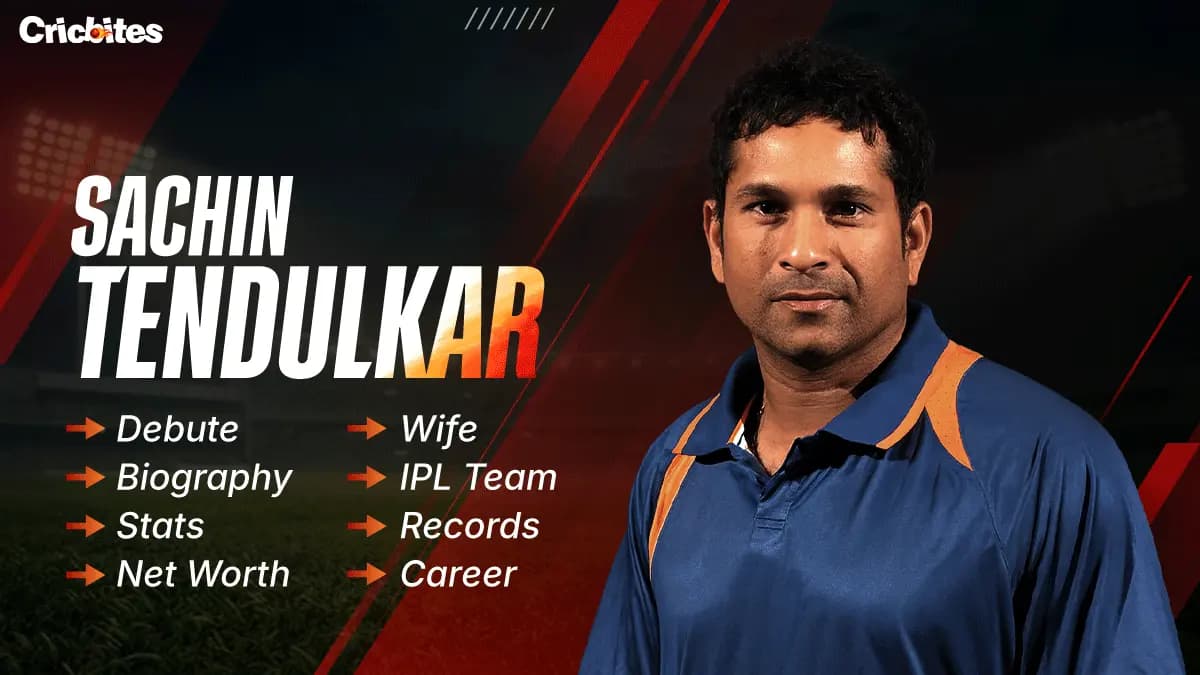
Sachin Tendulkar was more than just a batsman for India; he was an entire era embodied in one man. For twenty-four years, he stood in the middle of the pitch, carrying the weight of billions of expectations on his shoulders. Both Test and One-Day International cricket bowed before him, as he amassed numbers so staggering they seemed not merely statistical, but mythological. No one had scored so many runs before him. A hundred international centuries. A double century in ODIs, at a time when such feats were considered impossible.
India watched him grow old in the white and blue jersey. They watched him battle injuries, expectations, setbacks, and comebacks, and somehow, always endure. The pressure was relentless. The response was repetition. Another cover drive. Another straight drive. Another milestone acknowledged with quiet dignity.
Early Life and Biography
Sachin Ramesh Tendulkar was born on April 24, 1973. He was born in Bombay, which is now called Mumbai in Maharashtra, India. He is now fifty-two years old. He grew up in a middle-class family. His father worked, and his mother took care of the children. Cricket was everywhere in Mumbai. Boys played cricket in the streets. Sachin played too.
He started at a young age. When he was eleven years old, he began serious cricket training. His coach was Ramakant Achrekar. Achrekar saw talent in the boy. He trained him rigorously. Sachin practiced for hours every day. He didn’t mind. He loved cricket.
He is a right-handed player. He bats right-handed. He also occasionally bowls right-handed off-spin. But he was always primarily a batsman. Bowling was just something he could do if needed.
Domestic and International Debut
Tendulkar made his first-class debut for Bombay in the 1988-89 Ranji Trophy. He was fifteen years old. He scored 100 not out on his debut. This was extraordinary. Most players don’t score a century on their debut. Tendulkar did. People immediately took notice of him.
He played for Mumbai in the Ranji Trophy throughout his career. He was a top-order batsman. He was one of the highest run-scorers in Ranji history. Mumbai won many titles when Tendulkar was in the team. He was their best batsman.
He made his Test debut against Pakistan on November 15, 1989. He was sixteen years old. This made him the youngest Test cricketer for India. Pakistan had fast bowlers. They were aggressive. Tendulkar faced them. He was hit in the face. His nose started bleeding. He didn’t leave the field. He continued batting. This showed his courage.
He made his ODI debut against Pakistan on December 18, 1989. This was a month after his Test debut. He was still sixteen years old. He played one T20I in 2006. T20 cricket was new at that time. Tendulkar tried it. But he was primarily a Test and ODI player.
Biography Details
| Attribute | Details |
|---|---|
| Full Name | Sachin Ramesh Tendulkar |
| Date of Birth | 24 April 1973 |
| Age (2026) | 52 years |
| Birthplace | Nirmal Nursing Home, Dadar, Bombay (now Mumbai), Maharashtra, India |
| Nationality | Indian |
| Role | Batter |
| Batting Style | Right-handed bat |
| Bowling Style | Right-arm leg break (occasional) |
| Domestic Teams | Mumbai, Mumbai Indians, Yorkshire |
| International Team | India National Cricket Team |
| Marital Status | Married |
| Spouse | Anjali Tendulkar |
| Net Worth | Approx. ₹1,200–1,500 crore (various credible estimates) |
Career Batting Stats, Bowling Stats & Fielding Stats
Right-Handed Batsman
| Format | Years | M | Inn | NO | Runs | HS | Avg | BF | SR | 100s | 50s | 4s | 6s |
|---|---|---|---|---|---|---|---|---|---|---|---|---|---|
| Test | 1989–13 | 200 | 329 | 33 | 15,921 | 248* | 53.8 | — | — | 51 | 68 | — | — |
| ODI | 1989–12 | 463 | 452 | 41 | 18,426 | 200* | 44.8 | 21,367 | 86.2 | 49 | 96 | 2,016 | 195 |
| T20I | 2006 | 1 | 1 | 0 | 10 | 10 | 10.0 | 12 | 83.3 | 0 | 0 | 2 | 0 |
| IPL | 2008–13 | 78 | 78 | 11 | 2,334 | 100* | 34.8 | 1,948 | 119.8 | 1 | 13 | 295 | 29 |
Right-Arm Off-Spin
| Format | Years | M | Inn | B | Mdn | Runs | W | BB | Econ | Avg | SR | 4W | 5W |
|---|---|---|---|---|---|---|---|---|---|---|---|---|---|
| Test | 1989–13 | 200 | 145 | 4,240 | 83 | 2,492 | 46 | 3/10 | 3.53 | 54.2 | 92.2 | 0 | 0 |
| ODI | 1989–12 | 463 | 270 | 8,054 | 24 | 6,850 | 154 | 5/32 | 5.10 | 44.5 | 52.3 | 4 | 2 |
| T20I | 2006 | 1 | 1 | 15 | 0 | 12 | 1 | 1/12 | 4.80 | 12.0 | 15.0 | 0 | 0 |
| IPL | 2008–13 | 78 | 4 | 36 | 0 | 58 | 0 | 0/7 | 9.67 | — | — | 0 | 0 |
Fielding
| Format | Years | Catches | Run Outs | Stumpings |
|---|---|---|---|---|
| Test | 1989–13 | 115 | 8 | 0 |
| ODI | 1989–12 | 140 | 23 | 0 |
| T20I | 2006 | 1 | 0 | 0 |
Career
Tendulkar played for India for twenty-four years. He played from 1989 to 2013. It was a very long career. He played 200 Test matches. He played 463 One Day Internationals. He played one T20I. He scored runs in all of them.
He was India’s main batsman for two decades. When India needed runs, they looked to Tendulkar. He usually delivered. He was constantly under pressure. India is a cricket-mad country. The expectations were immense. Tendulkar handled it. He kept scoring runs. He kept performing.
He played in all conditions. He played in Australia where the pitches are fast and bouncy. He played in England where the ball swings. He played in South Africa where the bounce is uneven. He played on the subcontinent where the ball turns. He scored runs everywhere. He adapted to every condition.
He played against the world’s best bowlers. He faced Shane Warne and Glenn McGrath of Australia. He faced Wasim Akram and Waqar Younis of Pakistan. He faced Allan Donald and Shaun Pollock of South Africa. He faced them all. He scored runs against all of them.
He was consistently good. Some batsmen score big once and then fail. Tendulkar scored big regularly. He converted good starts into big scores. He built his innings carefully. He knew when to attack. He knew when to defend. He was a complete batsman.
He retired in 2013. His last Test was at the Wankhede Stadium in Mumbai. The crowd was massive. They had come to see him one last time. He scored fifty runs in his last innings.
IPL Career and Teams
Tendulkar played in the Indian Premier League. He made his IPL debut in 2008 for the Mumbai Indians. He played for the Mumbai Indians throughout his entire IPL career. He never played for any other team. Mumbai was his city. The Mumbai Indians were his team.
He was a top-order batsman and an icon of the team. He usually opened the batting. He provided the Mumbai Indians with good starts. He wasn’t as explosive as some other T20 batsmen, but he was consistently good. He scored runs regularly.
The Mumbai Indians won the IPL title in 2013. Tendulkar was part of that team. That was his last IPL season. He retired afterward. Winning the IPL was a great way to end his career. He was the league’s leading run-scorer in 2010. This shows that he could adapt to T20 cricket as well, even though it wasn’t his strongest format.
Playing Style and Strengths
Tendulkar’s main strengths were his timing and technical skill. He didn’t rely on brute force; he relied on placement. He could find the gaps in the field. He timed the ball perfectly. The ball would reach the boundary without requiring excessive power.
He adapted to all kinds of conditions. He could play fast bowling. He could play spin bowling. He could play on any pitch. He adapted his technique to the conditions. This is very rare. Most batsmen prefer certain conditions. Tendulkar could bat anywhere.
He was a prolific run-scorer. He scored runs in all formats. He scored runs in all countries. He scored runs against all teams. His consistency was remarkable. For twenty-four years, he maintained a high average. This requires discipline and skill.
He was a useful part-time off-break bowler. He didn’t bowl much, but he was occasionally called upon to break partnerships. Sometimes it worked. He took some important wickets in his career.
He was a capable and safe fielder. He wasn’t the best fielder in the team, but he was reliable. He caught whatever came his way. He saved runs. This benefited the team throughout his long career.
Read More: Wasim Akram Debut, Biography, Stats, Net Worth, Wife, IPL Team, Records, Career



Hello Readers! My name is Satyaki Das. I work as an SEO specialist and content writer at Cricbites.com and I have over 2 years of experience. I enjoy writing easy-to-read and engaging sports content, especially clear and helpful cricket stories for fans. I hope you enjoy my articles. Thanks for reading!