
Loading…

Top 10 Slowest Centuries in ODI Cricket History (2026 Updated List!)
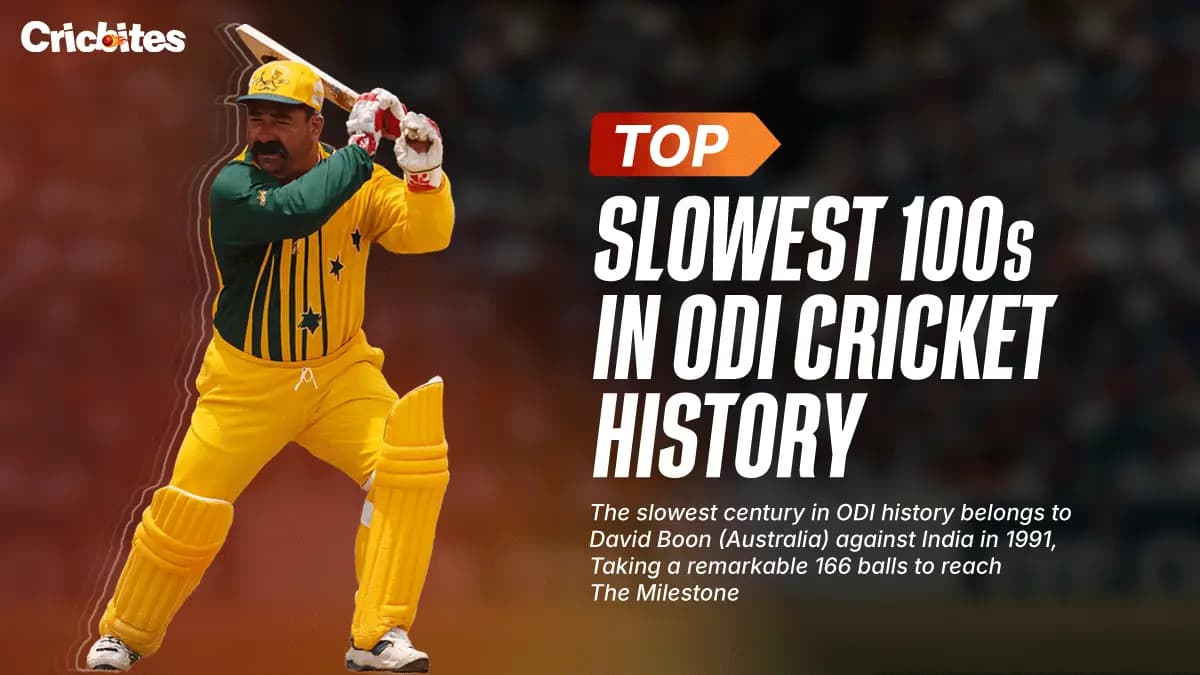
Cricket loves speed. Sixes. Fours. A strike rate of over 150. That’s what sells tickets. That’s what gets views. But sometimes, someone decides to do the exact opposite. They bat as if they have all the time in the world. They ignore the scoreboard. They frustrate everyone watching. And yet, somehow, they manage to score a century. These are the slowest centuries in ODI cricket history. Not the most entertaining. Not the most famous. But certainly the most stubborn. Some of these innings saved matches. Some were played on difficult pitches. Some were simply the result of poor planning. But all of them required courage. In a format where you’re expected to attack, these batsmen chose to defend. In a world obsessed with instant results, they chose patience. In a game that rewards aggression, they chose resilience. This list isn’t about fame. It’s about grit. It’s about batsmen who refused to get out, even if it meant boring everyone to death. Slow centuries. Big impact. Let’s begin..
Top 10 Slowest Centuries in ODI Cricket History
| Rank | Player | Balls to Reach 100 | Opponent | Year |
|---|---|---|---|---|
| 1 | David Boon (AUS) | 166 | India | 1991 |
| 2 | Rameez Raja (PAK) | 157 | West Indies | 1992 |
| 3 | Geoff Marsh (AUS) | 156 | England | 1989 |
| 4 | Rameez Raja (PAK) | 152 | Sri Lanka | 1990 |
| 5 | Scott Styris (NZ) | 152 | Sri Lanka | 2007 |
| 6 | Tom Cooper (NED) | 151 | Afghanistan | 2010 |
| 7 | Geoff Marsh (AUS) | 150 | West Indies | 1991 |
| 8 | David Hemp (BER) | 150 | Kenya | 2009 |
| 9 | Shai Hope (WI) | 149 | India | 2019 |
| 10 | David Boon (AUS) | 146 | West Indies | 1992 |
1. David Boon (AUS)
In December 1991, in Hobart, David Boon opened the batting for Australia, chasing a target of 176 against India. What followed was a magnificent display of unwavering determination. For 188 minutes, Boon remained unbeaten on 102, facing 168 balls. His century came off 166 balls and included just eight fours. With a strike rate of 60.71, this wasn’t batting for entertainment; it was batting to win. And Australia did win, reaching the target in 48.3 overs. Boon’s approach reminds us that cricket isn’t always about flamboyant strokeplay. Sometimes, it’s about getting the job done, accumulating runs one by one. The scoreboard doesn’t remember how you scored the runs; it only remembers that you scored them.
2. Rameez Raja (PAK)
Melbourne, February 1992, and the World Cup was in full swing. Pakistan batted first and scored 220 runs for the loss of two wickets, a rather low score even by the standards of the early 1990s. Opening the innings, Ramiz Raja scored 102 runs off 158 balls, reaching his century in 157 deliveries. Four boundaries in 181 minutes – that tells you everything you need to know about the tempo. With a strike rate of 64.55, Raja’s innings was incredibly slow and tedious to watch. And the saddest part? The West Indies chased down the target with all ten wickets intact, finishing the match in the 47th over. Sometimes in cricket, you can bat with all the patience in the world and still end up on the losing side. Raja’s innings serves as a reminder that staying at the crease, no matter how well you do it, needs to be balanced with the pressure of the scoreboard.
3. Geoff Marsh (AUS)
Lord’s, May 1989. If ever there was a place where taking your time at the crease seemed crucial, it was the home of cricket. England had posted 278 for 7 in their 55 overs, and Australia needed someone to anchor the chase. Geoff Marsh happily took on that responsibility. Opening the batting, he remained unbeaten on 111 runs off 162 balls. His century came off 156 balls, an innings that lasted 212 minutes and included seven fours and one six. With a strike rate of 68.51, Marsh kept Australia in the game throughout the entire match. The result? Australia won with just three balls to spare, finishing on 279 for 4. It wasn’t just about batting; it was about calculation, patience, and understanding what was required for the chase. Marsh showed that being slow doesn’t mean being ineffective.
4. Rameez Raja (PAK)
Adelaide, and Ramiz Raja features on this list again, this time against Sri Lanka in the Benson & Hedges World Series. Opening the batting with Saeed Anwar, Raja scored 107 runs off 154 balls, reaching his century in 152 deliveries. He spent 202 minutes at the crease, hitting just three boundaries, and his strike rate was 69.48. The interesting part? Pakistan still managed to reach 315 for 3 in their 50 overs. How? Saeed Anwar’s explosive innings of 126 runs off 99 balls provided the answer. While Raja played a slow innings, Anwar scored quickly. It’s a partnership dynamic as old as cricket itself: an anchor and an aggressor. Sri Lanka were restricted to 288 for 8, and Pakistan’s strategy, built on Raja’s patience, proved successful.
5. Scott Styris (NZ)
St. George’s, April 2007, and the World Cup was reaching its final stages. When Scott Styris came to the crease, New Zealand were 2 runs for 4 wickets. What followed was a rescue mission of immense courage. Styris remained unbeaten on 111 runs off 157 balls, reaching his century in 152 deliveries. In 198 minutes, with a strike rate of 70.7 and eight boundaries, New Zealand posted 219 for 7 wickets. It was a fighting innings, a magnificent innings that his team desperately needed. But sadly, Sri Lanka chased down the target with six wickets to spare in 45.1 overs. Styris had done everything right, yet cricket, with its boundless capacity for cruelty, had other plans. His innings stands as a testament to individual brilliance amidst collective failure.
6. Tom Cooper (NED)
In July 2010, the Netherlands faced Afghanistan in an ICC World League Division One match in Voorburg, Netherlands. Batting at number three, Tom Cooper scored 101 runs off 155 balls, reaching his century in 151 deliveries. He scored his runs at a strike rate of 65.16 in 180 minutes, hitting nine boundaries before being run out. The Netherlands posted 202 for 8, but Afghanistan chased down the target with six wickets to spare in 42.3 overs. This must have been a bittersweet experience for Cooper. A maiden ODI century is always special, but its significance is diminished when it comes in a losing cause, dulling the shine of any personal milestone.
7. Geoff Marsh (AUS)
Georgetown, March 1991, and Geoff Marsh was once again in superb form. Chasing 251 against the West Indies, Marsh opened the batting and anchored the Australian innings with a magnificent 106 off 158 balls. He reached his century off 150 balls, an innings that lasted 216 minutes and included eight boundaries. With a strike rate of 67.08, Marsh set the perfect tempo for the chase. Australia won the match by six wickets in 48.3 overs. It was a classic example of old-school ODI batting, where partnerships were built steadily, and the required run rate was managed rather than attacked. Marsh understood his role and played it flawlessly.
8. David Hemp (BER)
Potchefstroom, April 2009, and David Hemp was carrying Bermuda’s hopes against Kenya in the ICC World Cup Qualifiers. Opening the innings, Hemp scored 102 runs off 152 balls, reaching his century in 150 deliveries. His innings, which lasted 281 minutes and included nine fours, was played at a strike rate of 67.10, enabling Bermuda to post a total of 259 for 5. However, Kenya chased down the target with seven wickets and five overs to spare. For Hemp, representing Bermuda on cricket’s global stage, this century must have meant a great deal. The fact that it came in a losing cause does not diminish its significance.
9. Shai Hope (WI)
Chennai, December 2019, and suddenly we were transported back in time. Shai Hope unbeaten 102 off 151 balls, reaching his century in 149 deliveries, proved that slow centuries are not entirely a thing of the past. His innings, which included seven fours and a six, helped West Indies chase down a target of 288 runs. They won the match by eight wickets in 47.5 overs. Hope demonstrated that even in today’s cricket, when chasing a large total, there is still room for building an innings methodically and scoring runs at a steady pace.
10. David Boon (AUS)
David Boon features twice on this list. In a Benson & Hedges World Cup match against the West Indies, he opened the batting and remained unbeaten on 100 runs off 147 balls, reaching his century in 146 balls with the help of eight fours. Australia scored 216 for 6, and then bowled out the West Indies for 159. Boon’s century, though slow, proved to be a match-winning effort.
Read More: Shai Hope Debut, Biography, Stats, Net Worth, Wife, IPL Team, Records, Career



![Highest Individual Score in T20 World Cup History [2026 Updated List]](/_next/image/?url=https%3A%2F%2Fwww.cricbites.com%2Fwp%2Fwp-content%2Fuploads%2F2026%2F03%2Fhighest-individual-score-in-t20-world-cup-history.webp&w=256&q=75)


Hello Readers! My name is Satyaki Das. I work as an SEO specialist and content writer at Cricbites.com and I have over 2 years of experience. I enjoy writing easy-to-read and engaging sports content, especially clear and helpful cricket stories for fans. I hope you enjoy my articles. Thanks for reading!