

Loading…

Wisden Cricketer Of The Year List (1889-2025)
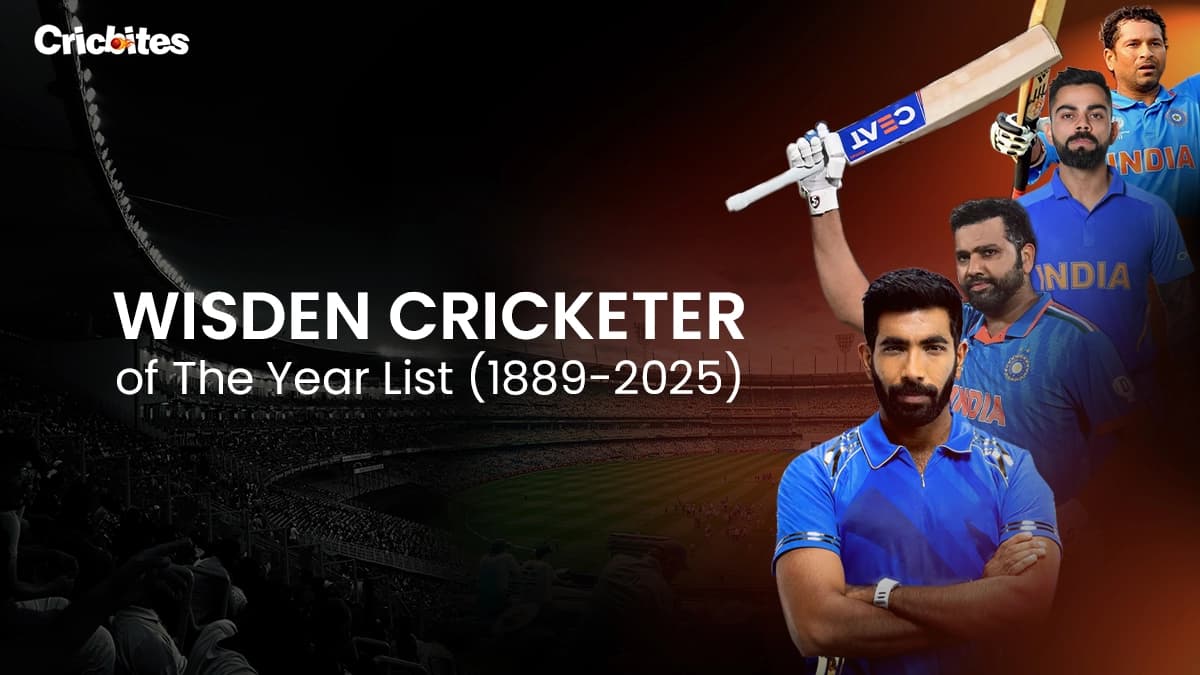
The Wisden Cricketers of the Year is a modest award with a long history. It began in 1889 and it has kept its place in the game. The award names players who defined an English season. It is not a lifetime prize. It is a mark for what was done in a year. The list that follows traces how the honour began, how it changed, and why it still matters. It keeps to the facts and to the plain work of cricket.
First 10-Year Recipients of the Wisden Cricketers of the Year (1889–1898)
| Year | Player 1 | Player 2 | Player 3 | Player 4 | Player 5 | Player 6 | Player 7 | Player 8 | Player 9 |
|---|---|---|---|---|---|---|---|---|---|
| 1889 | George Lohmann | Johnny Briggs | John Ferris | Charles Turner | Sammy Woods | Bobby Peel | – | – | – |
| 1890 | Bobby Abel | Billy Barnes | Billy Gunn | Louis Hall | Robert Henderson | Maurice Read | Arthur Shrewsbury | Frank Sugg | Albert Ward |
| 1891 | Jack Blackham | Gregor MacGregor | Dick Pilling | Mordecai Sherwin | Henry Wood | – | – | – | – |
| 1892 | William Attewell | J. T. Hearne | Frederick Martin | Arthur Mold | John Sharpe | – | – | – | – |
| 1893 | Herbie Hewett | Lionel Palairet | Walter Read | Stanley Scott | Andrew Stoddart | – | – | – | – |
| 1894 | George Giffen | Alec Hearne | Stanley Jackson | Harry Trott | Ted Wainwright | – | – | – | – |
| 1895 | Bill Brockwell | Jack Brown | C. B. Fry | Tom Hayward | Archie MacLaren | – | – | – | – |
| 1896 | W. G. Grace | – | – | – | – | – | – | – | – |
| 1897 | Syd Gregory | Dick Lilley | Ranjitsinhji | Tom Richardson | Hugh Trumble | – | – | – | – |
| 1898 | Frederick Bull | Willis Cuttell | Frank Druce | Gilbert Jessop | Jack Mason | – | – | – | – |
Recent 10-Year Recipients of the Wisden Cricketers of the Year (2016–2025)
| Year | Player 1 | Player 2 | Player 3 | Player 4 | Player 5 |
|---|---|---|---|---|---|
| 2016 | Jonny Bairstow | Brendon McCullum | Steve Smith | Ben Stokes | Kane Williamson |
| 2017 | Ben Duckett | Younis Khan | Misbah-ul-Haq | Toby Roland-Jones | Chris Woakes |
| 2018 | Shai Hope | Heather Knight | Jamie Porter | Natalie Sciver | Anya Shrubsole |
| 2019 | Tammy Beaumont | Rory Burns | Jos Buttler | Sam Curran | Virat Kohli |
| 2020 | Jofra Archer | Pat Cummins | Simon Harmer | Marnus Labuschagne | Ellyse Perry |
| 2021 | Zak Crawley | Jason Holder | Mohammad Rizwan | Dom Sibley | Darren Stevens |
| 2022 | Jasprit Bumrah | Devon Conway | Ollie Robinson | Rohit Sharma | Dane van Niekerk |
| 2023 | Tom Blundell | Ben Foakes | Harmanpreet Kaur | Daryl Mitchell | Matthew Potts |
| 2024 | Harry Brook | Ashleigh Gardner | Usman Khawaja | Mitchell Starc | Mark Wood |
| 2025 | Gus Atkinson | Liam Dawson | Sophie Ecclestone | Jamie Smith | Dan Worrall |
Origin and Purpose
The award was started in 1889. It was the first individual honour in cricket. In the first edition it was known as the six greatest bowlers of the year. The aim of the award was to recognise the players who had made the most impact on the English summer. It was to draw attention to the players who had changed the match and who had left their mark on the season. The aim was clear. It was to name the players whose work had been the most significant in the previous year.
Selection Criteria
Five cricketers are usually selected each year. The rule is that a player usually receives this honour only once. The selection is made on the basis of performance in the English season. The editors have some discretion. If a player has had an exceptional impact, the almanac can change the rules. This award is not just a numerical award. It is a decision about the impact and how the player defines the games and the season.
Early Years (1889–1910)
The early years were different in form and tone. In 1889 the first list included six players instead of five. W. G. Grace stands out in that era. He was the only player to be honoured in 1896. In the 1890s and early 1900s a mixed list of bowlers, batsmen and all-rounders was given. The game was different then, but the purpose of the almanac was the same. It named players who had played an important role in the English summer.
Special Honors and Exceptions
Wisden has shown that it can change its rules. In addition to the usual selections, two players received special honourable mentions. Plum Warner and Jack Hobbs were given such special mentions. War and other disruptions also affected the lists. The First and Second World Wars caused gaps and necessitated changes. This special honour emphasises the prestige of the award and its readiness to adapt as history demands.
Evolution Over Time
The award has evolved with the game. Since 1926, almost every annual almanac has listed five players. For a brief period from 2000 to 2003, the award moved beyond the English season to focus on global influence. It was a small experiment. In 2004, Wisden introduced a separate award, the Wisden Leading Cricketer in the World. Cricketers of the Year then returned to its traditional criteria, the players who defined the English summer. The evolution represents a balance between tradition and the need to recognise a changing game.
Inclusion of Women
The list became more extensive in 2009. Claire Taylor became the first woman to be named Wisden Cricketer of the Year. It was a clear milestone. It marked a change in the way the game and the almanac viewed women’s cricket. Since then, women have appeared more regularly among the annual award recipients. The inclusion is not symbolic. It is a recognition that the game’s best work can come from any player who shapes the season in England.
Notable Winners Through History
The list of winners reads like a map of cricket’s greats. Sir Donald Bradman was Cricketer of the Year in 1931. Viv Richards appeared in 1977. Imran Khan was honoured in 1983. Waqar Younis was named in 1992. In modern times, players like Virat Kohli in 2019 and Jasprit Bumrah in 2022 have been recognised. The list is a mix of eras and styles. It shows how the award has named both old masters and modern stars.
2020s Recipients Highlights
The 2020s decade is taking shape. The 2019 winners include Tammy Beaumont, Rory Burns, Jos Buttler, Sam Curran and Virat Kohli. The 2020 list includes Ben Stokes, Pat Cummins, Marnus Labuschagne, Simon Harmer and Ellyse Perry. The five winners for 2025 include Gus Atkinson, Jamie Smith, Sophie Ecclestone, Liam Dawson and Dan Worrall. These names show how the modern game of cricket and the award still looks to the English season for its measure. They also show that the award values performance over statistics in both men’s and women’s cricket.
Legacy and Impact
The Wisden Cricketers of the Year is one of cricket’s most respected individual honours. Inclusion on the list recognises exceptional performance in English cricket. The award does not measure a career. It measures the impact of a single season, not the length of a career. Many winners have been considered among the greatest players of their era. The honour carries weight because it connects a player to a moment and the work done in that moment. It shapes public memory and helps to define a generation.
Read More: ICC Cricket Hall of Fame: Full List of Inductee Cricketers (2009–2025)
Comparison With Other Awards
Wisden’s World Cricketer of the Year is a different matter. It allows for repeat winners and it measures a wider span. Some players have won both Wisden honours, such as Kumar Sangakkara. The Cricketers of the Year list is unique in that it focuses on season performances rather than career records. It is an award that looks at the English summer and asks who changed it. This focus gives it a unique place among cricket’s many awards.

Hello Friends! My name is Harshil Raval. I work as an SEO Lead at Cricbites.com. I have over 4 years of experience. I am very passionate about writing about sports, especially cricket. I try to write in very simple and clear terms so that everyone can understand, even young readers. I enjoy sharing interesting match stories, player news, and helpful cricket information for fans. Writing about cricket makes me happy, and I always try to make my articles interesting and easy to read. I hope you enjoy reading my stories. Thank you very much for your support!