

Loading…

Belinda Clark Debut, Stats, Age, Net Worth, Records, Bio & ICC Ranking
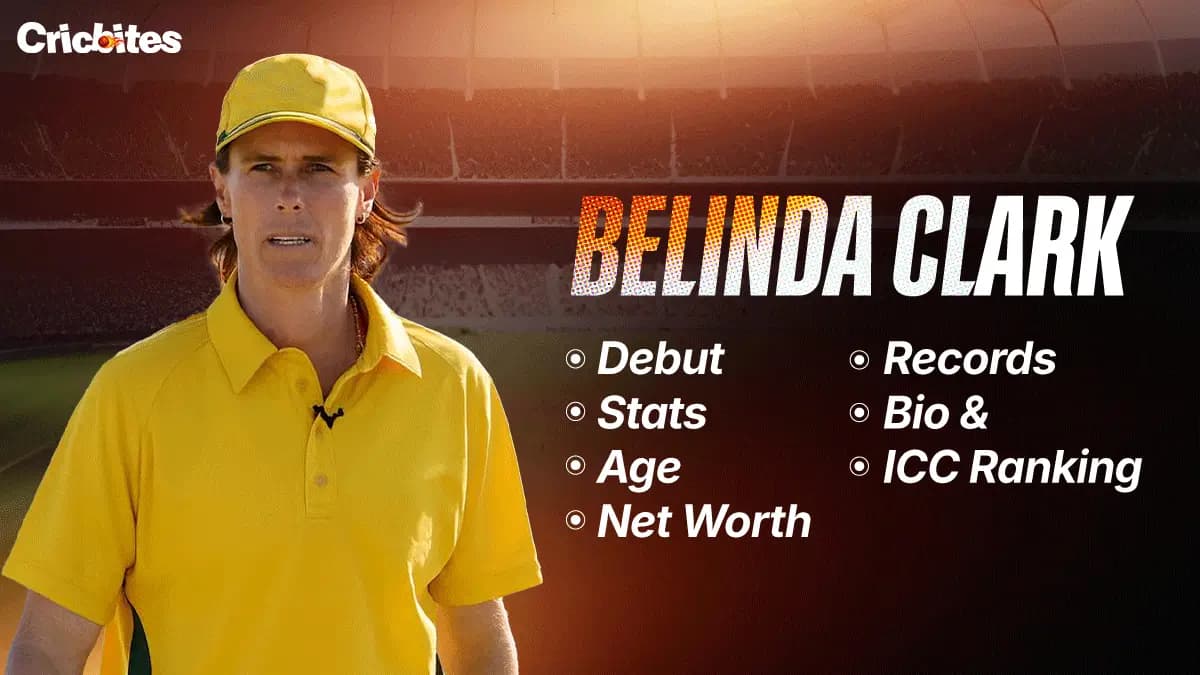
In every era, there’s a player who changes the course of the game. For women’s cricket, that player was Belinda Clark. She was playing cricket at a time when women’s cricket was barely known. She was rewriting what was possible. Now, she has a statue at the Sydney Cricket Ground, right alongside Richie Benaud and Steve Waugh. It’s the world’s first bronze statue of a female cricketer. And if you understand what that location represents, you’ll understand what Clark means to Australian cricket.
Early Age
Born on September 10, 1970, in Newcastle, New South Wales, Clark is now 55 years old. She grew up in a sporting family. Her father, Alan, was a school teacher and an inter-district cricketer. Her mother, Margaret, was a state tennis champion. Before she even considered cricket, Clark dreamed of winning Wimbledon. She would spend hours hitting tennis balls against her garage door and a brick wall, honing the hand-eye coordination that would later devastate bowling attacks. She didn’t start playing girls’ cricket until she was 13, at Newcastle High School. Sally Griffiths, also from Newcastle, would take her to Sydney on weekends so she could play for Gordon District Cricket Club. That’s where it all began.
International Debut
Clarke made her international cricket debut on January 17, 1991, against New Zealand at Bellerive Oval. She opened the batting and scored 36 runs in a One Day International match, which her team won. Nothing spectacular, but a solid start. Less than two weeks later, she made her Test debut against India at North Sydney Oval. This time, she scored a century. In her very first Test match. Think about the pressure, the expectations, and she just went out there and scored a hundred. The match ended in a draw, but Clarke had proven herself. She was 20 years old, and she had announced to the cricketing world that she was here to stay.
Biography Details
| Full Name | Belinda Jane Clark |
|---|---|
| Date of Birth | 10 September 1970 |
| Age | 55 years (as of 2025) |
| Birthplace | Newcastle, New South Wales, Australia |
| Nationality | Australian |
| Role | Top-order batter |
| Batting Style | Right-handed |
| Bowling Style | Right-arm medium (occasional) |
| Domestic Team | New South Wales |
| International Team | Australia Women |
| Net Worth | USD 1–2 million (approx.) |
Career Stats
The statistics speak for themselves. In ODIs, Clark scored 4,844 runs in 118 matches at an average of 47.49, including five centuries. In Tests, she played 15 matches and scored 919 runs at an average of 45.95. Her best Test score was 136 against England in Worcester in 1998. But what’s truly remarkable about Clark is this: she wasn’t just scoring runs; she was also captaining the team. She captained Australia in 101 ODIs, with a win rate of 83 percent. That’s not just good; it’s phenomenal.
Career Batter Stats, Bowling Stats & Fielding Stats
Right-Handed Batter
| Format | Innings | Runs | HS | AVG | 100s | 50s |
|---|---|---|---|---|---|---|
| Test (1991-2005) | 25 | 919 | 136 | 45.95 | 2 | 6 |
| ODI (1991-2005) | 114 | 4844 | 229* | 47.49 | 5 | 30 |
| T20I (2004) | 1 | 4 | 4 | 4.00 | 0 | 0 |
Right-arm mediumBowler
| Format | Overs | Wickets | Best | Average |
|---|---|---|---|---|
| Test (1991–2005) | – | – | – | – |
| ODI (1991–2005) | 5 | 1 | 1/12 | 12.00 |
| T20I (2004) | – | – | – | – |
Fielding Stats
| Format | Catches | Stumpings |
|---|---|---|
| Test (1991–2005) | 4 | 0 |
| ODI (1991–2005) | 45 | 0 |
| T20I (2004) | 1 | 0 |
Net Worth
There is no definitive public information regarding Clark’s exact net worth. Various online sources estimate it to be between $80,000 and $5 million, but these figures are not reliable. What we do know for certain is that Clark played during an era when female cricketers did not receive the same salaries as their male counterparts. She combined playing with administrative roles, captaining the team and also serving as the Chief Executive Officer of Women’s Cricket Australia. After retirement, she held several positions at Cricket Australia, managed the National Cricket Centre in Brisbane, and later became an Executive General Manager. In 2020, she launched her own business, The Leadership Playground, which helps young girls develop leadership skills.
Records
Belinda Clark became the first player in cricket history, male or female, to score a double century in a One Day International (ODI) when she made an unbeaten 229 against Denmark in Mumbai during the 1997 World Cup. This record stood as the highest individual score in women’s ODIs for over 20 years until it was broken in 2018 by New Zealand’s Amelia Kerr, who scored an unbeaten 232. In 1997, Clark scored 970 runs in ODIs, a record for the most runs scored by any player in women’s cricket in a calendar year. She holds the record for the most Test runs, most ODI runs, and most ODI matches played for Australia. She led Australia to World Cup victories in 1997 and 2005, with her team remaining undefeated throughout the tournament in South Africa in 2005.
Bio & ICC Ranking
Belinda Clark’s career spanned from 1991 to 2005, a time when women’s cricket was struggling to gain recognition. She became captain in 1994 after Australia’s poor World Cup performance in 1993, and under her leadership, Australian women’s cricket experienced its golden age. She led from the front, exemplified by her memorable innings of 142 against New Zealand at Eden Park, where the next highest score by any other player on her team was just 28. She won the Wisden Australia Cricketer of the Year award in 1998. Even after retirement, the accolades continued. She was inducted into the ICC Cricket Hall of Fame in 2011, becoming only the second woman to receive this honor. In 2014, she became the first woman inducted into the Australian Cricket Hall of Fame. She was appointed a Member of the Order of Australia in 2000 and promoted to Officer in 2018. The highest individual award for women at the Australian Cricket Awards is named the Belinda Clark Award. She is not just a part of cricket history; she helped write it.
Read More: Sarah Taylor Debut, Stats, Age, Net Worth, Records, Bio & ICC Ranking
Conclusion
Belinda Clark’s story is successful for this very reason. She didn’t just perform brilliantly when no one was watching. She made people watch. She made people care. That double century against Denmark? It wasn’t just a personal milestone. It was a statement that women’s cricket deserves the same attention, respect, and recognition as men’s cricket. Her statue at the SCG isn’t there because of nostalgia. It’s there because she changed the game. She proved that leadership and excellence have no gender. She created something for others to build upon. And in cricket, in sport, in life, perhaps that is the greatest achievement of all.
FAQs: Frequently Asked Questions
Q1. When did Belinda Clark make her international debut?
Clarke made his international cricket debut against New Zealand at Bellerive Oval on January 17, 1991.
Q2. Did Belinda Clark score a century on her Test debut?
Less than two weeks later, he made his Test debut against India at North Sydney Oval. This time, he scored a century.
Q3. What is Belinda Clark’s most famous record in ODI cricket?
Clark became the first player in cricket history, male or female, to score a double century in a One Day International. She remained unbeaten on 229 runs against Denmark in Mumbai during the 1997 World Cup.
Q4. How successful was Belinda Clark as captain of Australia?
He captained Australia in 101 ODIs and had a win rate of 83 percent.
Q5. Why is there a statue of Belinda Clark at the Sydney Cricket Ground?
This is the first bronze statue of a female cricketer in the world.






Hello Readers! My name is Satyaki Das. I work as an SEO specialist and content writer at Cricbites.com and I have over 2 years of experience. I enjoy writing easy-to-read and engaging sports content, especially clear and helpful cricket stories for fans. I hope you enjoy my articles. Thanks for reading!