
Loading…

What Is a Concussion Substitute in Cricket? Full Rules & Examples
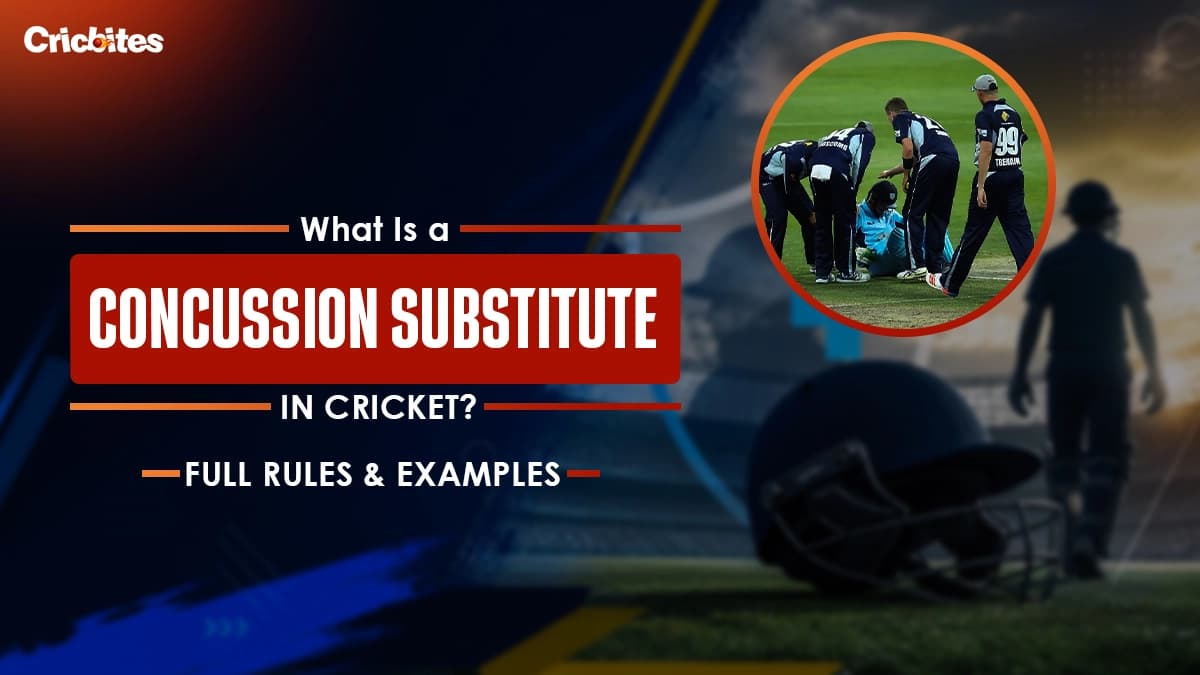
Cricket has changed a lot over time when it comes to player safety. Earlier, players would take a hit to the head, stand for a few seconds and try to carry on as if nothing had happened. But gradually the game realized something important. The human brain is not something you can just ignore and hope for the best.
Thus, concussion alternatives became part of the modern cricket laws. Not as a minor change, but as a serious shift in thinking. If a player suffers a head or neck injury, the team is allowed to replace him. But there is one condition. The replacement must be equal. The team does not need to be upgraded. There is no clever advantage. Only fairness with safety.
The International Cricket Council introduced this rule on 1 August 2019 in all major formats, including T20 and first-class cricket. On that date, it quietly changed the way teams deal with injuries forever.
What is a Concussion?
A concussion occurs when the brain is suddenly hit inside the skull. In cricket, it is usually caused by a fast ball, a bad fall, or an accidental collision.
It is considered a mild traumatic brain injury, but its effects are not always mild. The player may experience dizziness, confusion, or a headache that does not go away quickly.
The dangerous part is that the symptoms do not always appear immediately. A player may look fine on the outside but be injured on the inside. That is why a medical check-up in these situations is not optional. It is necessary every time.
Most players recover completely, but only if they rest properly and return at the right time. Returning too early can turn a minor injury into a serious problem.
What is the Concussion Substitution Rule in Cricket?
If a player is suspected of having suffered a concussion during a match, a team can request a substitution. But this is not automatic and is not emotional. It is governed by strict rules.
First, the injury must occur during active play on the field. Second, a qualified medical staff member must confirm the concussion or suspicion of it.
The team must then send a formal concussion substitution request to the ICC Match Referee. This includes details of the incident, a medical assessment and the name of the player being substituted.
The Match Referee has the final decision. There is no appeal and no second opinion. Once granted, the decision is final.
Also Read: What is The Hundred Cricket Format? Rules, Teams and How It Differs from T20
Like for Like Concussion Substitute
This rule is the most important part of the system. The replacement player must have the same role and skill as the injured player. If an opening batsman is injured, you cannot replace him with a specialist bowler to gain an advantage. The referee checks whether the replacement matches the potential role of the original player.
The restrictions go further. If the injured player is not allowed to bowl at that time, the replacement cannot bowl either. Once a replacement is approved, the original player does not take any further part in the match. Instead, the replacement continues. Both names are recorded in the statistics, but only one player plays for the rest of the game.
In 2025, the system became more structured. Teams now have to name five replacement players before the toss. These include the wicketkeeper, batsman, fast bowler, spinner and all-rounder. Additionally, any player diagnosed with a concussion must observe a minimum seven-day rest period before returning to professional cricket.
If a replacement player is also injured, a second replacement player may be allowed, but only under conditions approved by the match referee.
Example of the Concussion Substitute Rule
Steve Smith went into Lord’s in 2019 with all his might, a player who never stops a ball. Then a short ball from Jofra Archer changed everything in a matter of seconds. The ball hit him hard in the neck area and suddenly the match felt different, not just for him but for both teams.
He tried to move forward, turned around, got out of it, but later medical signs showed concussion and he was given out. Something new was seen in cricket at that time. Marnus Labuschagne came on as the first concussion substitute in Test cricket history and suddenly a rule became a real-life one.
No drama, no delay, just a substitution under strict medical clearance. He batted with calm focus, stayed there long enough to show why the rule was important, and the game went on as if he had planned everything in advance. That moment at Lord’s became a turning point in player safety, showing that cricket now protects players even in its toughest battles.
Conclusion
The Concussion Substitute Rule shows how cricket has evolved beyond just competition. It is no longer just about runs, wickets and results. It is also about safety and accountability. The system ensures that injuries do not do injustice to the team, while also ensuring that the rules are not abused for tactical advantage.
Ultimately, it is cricket that tries to do something very simple but very important. Protect the player, protect fairness and keep the spirit of the game intact.
Read More: How Are Cricket Pitches Prepared? The Full Step-by-Step Process
FAQs: Frequently Asked Questions
Q1. What is a concussion substitute in cricket?
One player goes out with a head injury and another comes in to keep the game fair and safe.
Q2. When did this rule start?
The International Cricket Council implemented it on 1 August 2019.
Q3. What is a concussion?
It is a blow to the head that jolts the brain and slows everything down inside.
Q4. Who decides the substitute?
The match referee makes the decision, and that decision is without discussion.
Q5. What is a like-for-like replacement?
This means that the new player must be the same as the one who left, no more and no less.