

Loading…

10 Slowest Fifties in Women’s Test Cricket History (2026 List)
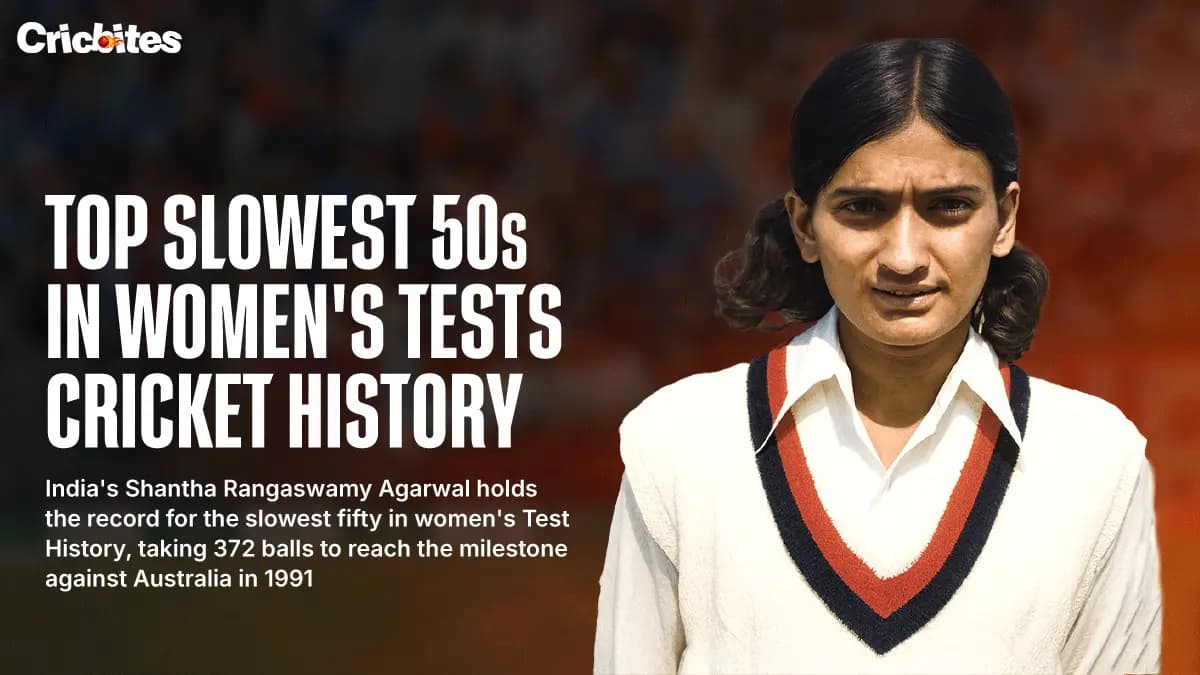
Test cricket is the longest format of the game. Batsmen have plenty of time. They don’t need to rush. They can build their innings gradually. They can stay at the crease for hours. Sometimes, the circumstances demand slow batting. The pitch might be difficult. The bowling might be consistently good. Wickets might be falling. In such situations, staying at the crease is more important than scoring runs quickly. These ten batsmen have scored the slowest half-centuries in the history of women’s Test cricket. The slowness is measured by the number of balls faced. Some faced more than two hundred balls. Some faced more than three hundred. Each innings had its own context. Each batter did what the match required.
Top 10 Slowest Fifties in Women’s Tests Cricket History
1. Sandhya Agarwal (India)
Agarwal played 372 balls to score fifty runs against the Australian women’s team at North Sydney Oval in the 1990/91 season.
372 balls is the slowest half-century ever scored in women’s Test cricket. No one has ever taken so long. Agarwal was playing in Australia. The conditions were unfamiliar. Australia bowled well. The pitch was difficult. Agarwal had to defend every ball. She had to stay at the crease.
She played cautiously. She left the balls outside the off-stump. She defended the straight balls. She only scored runs when the ball was bad enough to hit. But there were very few bad balls. Australia bowled with discipline. They didn’t give her any opportunities. 372 balls went by before she reached fifty runs. It required immense concentration. It required more patience than most batsmen possess. India needed someone to stay at the crease. Agarwal stayed at the crease for 372 balls.
2. Anne McKenna (New Zealand)
In 1984, McKenna needed 296 balls to score fifty runs against the England women’s team at Headingley in Leeds.
296 balls is a very slow pace. McKenna was playing in England. Headingley is a famous ground. England bowled well there. McKenna came in and had to play cautiously. The conditions were favorable for the bowlers. The ball was swinging in the air. It was also turning off the pitch. McKenna defended well. She left many balls alone. She scored runs slowly and carefully. She reached that milestone in 296 balls. New Zealand needed someone who could stay at the crease. McKenna did that job.
3. Laura Alexandra Marsh (England)
In 2013, at Sir Paul Getty’s ground in Wormsley, Marsh scored 50 runs off 291 balls against the Australian women’s team.
291 balls is the third slowest half-century in women’s Test cricket. Marsh was playing at Wormsley, which is a private ground. Australia bowled with discipline, and Marsh was unable to score freely. She defended every ball and scored very slowly. She rotated the strike whenever the opportunity arose, but mostly she defended the ball. 291 balls had passed before she reached 50 runs. England needed time at the crease, and Marsh gave them that time.
4. Arran Brindle (England)
Brindle faced 274 balls to score 50 runs against the Indian women’s team at the KD Singh Babu Stadium in Lucknow during the 2001/02 season.
Even for Test cricket, 274 balls for 50 runs is incredibly slow. Brindle was playing in India. The conditions were hot and challenging. India bowled well. Brindle had to play cautiously. She played each ball on its merits. She scored runs whenever the opportunity arose, but those opportunities were few and far between. It took her 274 balls to reach that milestone. England needed stability, and Brindle provided that stability with patience and concentration.
5. Maria Frances Fahey (New Zealand)
In the 2003/04 season, at the Shri GM Bilakhia Stadium in Vapi, Fehi played 266 balls to score fifty runs against the Indian women’s team.
266 balls is the fifth slowest fifty ever scored. Fehi was playing in India. Vapi is not a major cricket ground. The conditions were difficult. India bowled with discipline. Fehi defended every ball. She took no risks. She built her innings slowly over several hours. 266 balls had passed before she reached this milestone. New Zealand needed a player who could stay at the crease. Fehi stayed at the crease with determination and patience.
6. Deborah Ann Hockley (New Zealand)
In the 1991/92 season, Hockley needed two hundred and fifty-one balls to score 50 runs against the England women’s team at Pukekura Park in New Plymouth.
Two hundred and fifty-one balls on her home ground in New Zealand. Hockley was playing in front of her home crowd. England bowled well. Hockley couldn’t score freely. She defended cautiously. She played every ball with concentration. She scored runs very slowly. She scored 50 runs off two hundred and fifty-one balls. New Zealand needed time at the crease. Hockley gave them that time.
7. Caroline Mary Ghislaine Atkins (England)
During the 2001/02 season, Atkins scored 50 runs off 247 balls against the India women’s team at the KD Singh Babu Stadium in Lucknow.
In the same match and on the same ground where Brindle had batted slowly, Atkins also faced 247 balls. The conditions were difficult for both English batters. Atkins came in and had to play cautiously. India bowled well, and the pitch wasn’t easy. Atkins defended almost every ball, only scoring runs when the opportunity arose. But mostly, she was defending. 247 balls had passed before she reached this milestone. England needed stability in those challenging conditions, and Atkins provided it.
8. Deborah Ann Hockley (New Zealand)
Hockley appears on this list again. In the 1994/95 season, she faced 244 balls to score a half-century against the Indian women’s team at Trafalgar Park in Nelson.
The 244 balls demonstrate that Hockley could bat slowly when needed. She was playing on her home ground in Nelson. India bowled with discipline. Hockley defended cautiously. She built her innings over several hours. She didn’t rush. She didn’t take unnecessary risks. It took her 244 balls to reach that milestone. Hockley appears on this list twice. This highlights her ability to stay at the crease for extended periods.
9. Janette Ann Brittin (England)
In 1998, at the County Ground in Worcester, Brittin needed two hundred and thirty-eight balls to score fifty runs against the Australian women’s team.
Two hundred and thirty-eight balls in Worcester. Brittin was playing on her home ground. Australia bowled well. Brittin couldn’t score freely. She defended cautiously. She played every ball carefully. She scored very slowly for a long time. Two hundred and thirty-eight balls passed before she reached fifty runs. England needed someone to hold the crease against the Australian bowling attack. Brittin did just that.
10. Haidee Mary Tiffen (New Zealand)
In the 2003/04 season, at the Shri GM Bilakhia Stadium in Vapi, Tiffen scored 50 runs off 235 balls against the Indian women’s team.
It was the same ground where Fahey had also batted slowly, taking 235 balls for her innings. The conditions in Vapi were difficult for the New Zealand batters. Tiffen came in and had to play cautiously. India bowled with discipline. The pitch wasn’t easy for batting. Tiffen defended every ball. She scored runs whenever the opportunity arose, but those opportunities were few and far between. It took her 235 balls to reach this milestone. In difficult circumstances, New Zealand needed someone to hold the crease, and Tiffen, with her patience and determination, provided them with that crucial time.
Read More: Top 10 Slowest Fifties in Women’s ODI Cricket History (2026 Update)






Hello Readers! My name is Satyaki Das. I work as an SEO specialist and content writer at Cricbites.com and I have over 2 years of experience. I enjoy writing easy-to-read and engaging sports content, especially clear and helpful cricket stories for fans. I hope you enjoy my articles. Thanks for reading!