

Loading…

Most Centuries in Cricket History (Tests+ODIs+T20ls)
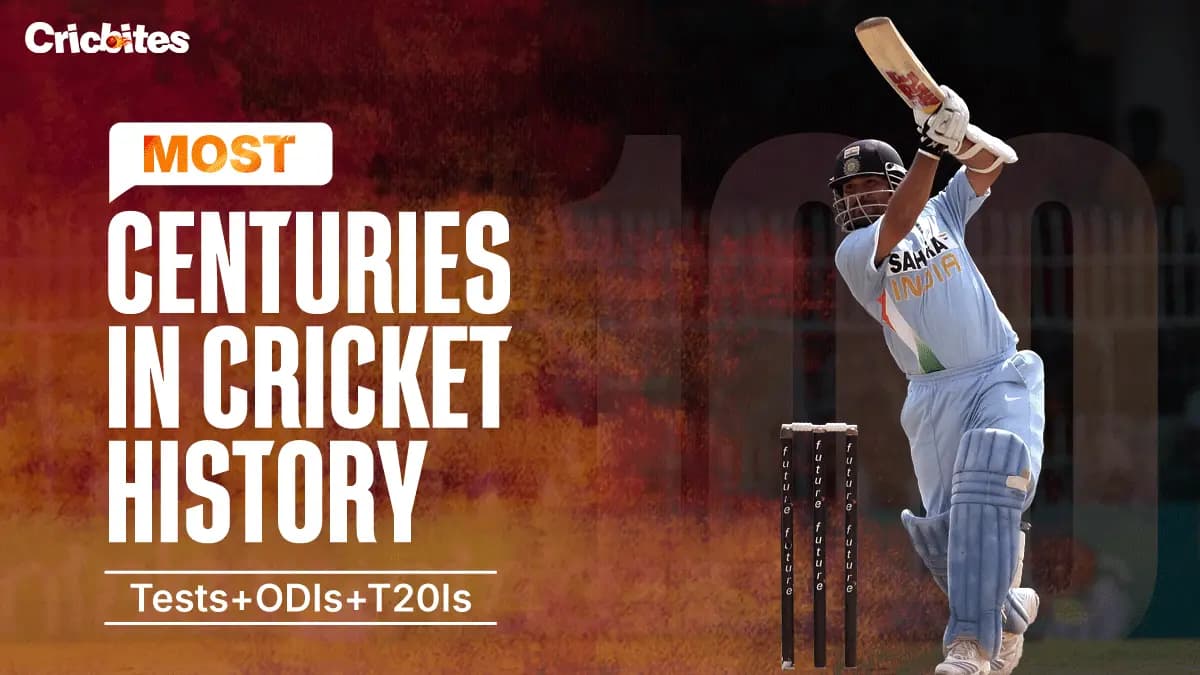
A century means scoring one hundred runs. In cricket, it’s a major achievement. It proves that you can play a good innings, maintain focus, and handle pressure. Scoring a century in international cricket is an accomplishment that many batsmen never achieve. Ten batsmen have scored more centuries than anyone else in Tests, ODIs, and T20Is combined. These players are from India, Australia, Sri Lanka, South Africa, England, and the West Indies. The player at the top of the list has scored one hundred international centuries. The player at number ten on the list has scored fifty centuries. These are all remarkable careers, measured by years of consistent, outstanding performance.
Most Centuries in Cricket History (Tests+ODIs+T20ls)
| Rank | Player | Period | Team | Test 100s | ODI 100s | T20I 100s | Total 100s |
|---|---|---|---|---|---|---|---|
| 1 | Sachin Tendulkar | 1989–2013 | India | 51 | 49 | 0 | 100 |
| 2 | Virat Kohli | 2008–2026 | India | 30 | 54 | 1 | 85 |
| 3 | Ricky Ponting | 1995–2012 | Australia | 41 | 30 | 0 | 71 |
| 4 | Kumar Sangakkara | 2000–2015 | Sri Lanka | 38 | 25 | 0 | 63 |
| 5 | Jacques Kallis | 1995–2014 | South Africa | 45 | 17 | 0 | 62 |
| 6 | Joe Root | 2012–2026 | England | 41 | 19 | 0 | 60 |
| 7 | Hashim Amla | 2004–2019 | South Africa | 28 | 27 | 0 | 55 |
| 8 | Mahela Jayawardene | 1997–2015 | Sri Lanka | 34 | 19 | 1 | 54 |
| 9 | Brian Lara | 1990–2007 | West Indies | 34 | 19 | – | 53 |
| 10 | Rohit Sharma | 2007–2026 | India | 12 | 33 | 5 | 50 |
1. Sachin Tendulkar
Sachin Tendulkar is from India. His career spanned from 1989 to 2013. He scored fifty-one Test centuries and forty-nine One Day International (ODI) centuries. When T20Is became common, he never played a T20I for India. He has a total of one hundred international centuries to his name. He is the only player in history to have achieved this feat.
One hundred centuries means one hundred different innings in which he scored more than one hundred runs. The consistency required to achieve this is unparalleled. He played at the international level for twenty-four years. He faced the best bowlers of different eras and in different conditions. He scored centuries everywhere, against everyone. Against fast bowlers. Against spinners. In India. In Australia. In England. Everywhere.
When he retired, cricket lost its highest run-scorer. His records will stand for generations. No current player is even close to one hundred international centuries. Tendulkar has set a standard that may never be equaled.
2. Virat Kohli
Indian cricketer Virat Kohli. His career spans from 2008 to 2026. He has scored thirty Test centuries, fifty-four ODI centuries, and one T20I century. He has a total of eighty-five international centuries to his name. He is the leading batsman of the modern era in ODIs.
Eighty-five centuries mean he is chasing Sachin Tendulkar’s record. His fifty-four ODI centuries are more than Tendulkar’s forty-nine. Kohli is the player with the most centuries in ODI cricket history. His conversion rate from fifty to one hundred runs is exceptional. When he crosses fifty runs, he usually goes on to score a century.
He is still playing. If he continues to play for a few more years, he could come close to Tendulkar’s record of one hundred international centuries. The cricketing world is waiting to see if he can reach that milestone. Every century Kohli scores brings him closer to making history.
3. Ricky Ponting
Ricky Ponting is from Australia. His career spanned from 1995 to 2012. He scored forty-one Test centuries and thirty One Day International (ODI) centuries. He did not regularly play Twenty20 Internationals (T20Is). He has a total of seventy-one international centuries to his name. He captained Australia and led them to World Cup victories.
Seventy-one centuries over seventeen years demonstrate consistent excellence. Ponting was known for his aggressive batting and brilliant fielding. As captain, he led Australia during its most dominant era. He won almost everything. He continued to score centuries regularly even while handling the pressures of captaincy.
His forty-one Test centuries show that he could play long innings over several days. His thirty ODI centuries show that he could score quickly when needed. He was a complete batsman in all formats of the game.
4. Kumar Sangakkara
Sri Lankan cricketer Kumar Sangakkara. His career spanned from 2000 to 2015. He scored thirty-eight Test centuries and twenty-five One Day International (ODI) centuries, for a total of sixty-three international centuries. He is one of Sri Lanka’s greatest batsmen.
For most of his career, Sangakkara was a wicketkeeper-batsman. Wicketkeeping is a physically demanding job. Scoring sixty-three centuries while also keeping wickets demonstrates his exceptional fitness and concentration. In the later stages of his career, he gave up wicketkeeping to focus on his batting, which further improved his performance.
Sixty-three centuries in fifteen years means an average of more than four centuries per year. This consistency made him invaluable to Sri Lanka. They relied on him to consistently score big runs, and he delivered.
5. Jacques Kallis
Jacques Kallis is from South Africa. His career spanned from 1995 to 2014. He scored forty-five Test centuries and seventeen One Day International (ODI) centuries, for a total of sixty-two international centuries. He was a great all-rounder.
Kallis excelled in both batting and bowling at the international level. He took over 290 Test wickets while scoring sixty-two centuries. No other player has achieved such a feat in both batting and bowling. His forty-five Test centuries demonstrate that, despite his bowling responsibilities, he was one of the greatest Test batsmen of all time.
The relatively lower number of his ODI centuries is due to South Africa utilizing him in various roles in limited-overs cricket. However, scoring a total of sixty-two centuries while also being a front-line bowler is exceptional. He contributed more to his team than almost any other player in history.
6. Joe Root
England cricketer Joe Root. His career spans from 2012 to 2026. He has scored forty-one Test centuries and nineteen ODI centuries. He has a total of sixty international centuries. He is England’s highest run-scorer in Test cricket.
His forty-one Test centuries equal the total number of centuries scored by Ricky Ponting. Root is a master of Test cricket. He bats at number four. He builds his innings in a methodical manner. He consistently converts good starts into centuries. His technique is classical. He plays long innings in diverse conditions.
He is still playing. If he continues to play for a few more years, his Test centuries could reach fifty or more. His sixty international centuries have already placed him among England’s greatest batsmen.
7. Hashim Amla
Hashim Amla is from South Africa. His career spanned from 2004 to 2019. He scored twenty-eight Test centuries and twenty-seven One Day International centuries, for a total of fifty-five international centuries. He was known for his elegant and consistent batting.
The balance between his Test and ODI centuries is a testament to his skill. Twenty-eight Test centuries demonstrate his ability to play long innings, while twenty-seven ODI centuries show his capacity to score quickly when needed. His technique was effective across all formats.
Amla’s batting was a joy to watch. But elegant batting is meaningless without effective batting. He was effective. Fifty-five international centuries over fifteen years are proof of his consistently excellent performance.
Read More: Top 10 Slowest Centuries in ODI Cricket History (2026 Updated List!)
8. Mahela Jayawardene
Sri Lankan cricketer Mahela Jayawardene. His career spanned from 1997 to 2015. He scored thirty-four Test centuries, nineteen ODI centuries, and one T20I century. He has a total of fifty-four international centuries to his name. He was a key player during Sri Lanka’s golden era of cricket.
Jayawardene and Sangakkara formed one of the greatest batting partnerships in cricket history. They batted together for Sri Lanka for over a decade, accumulating a massive number of runs. Jayawardene’s fifty-four centuries were a testament to his classical technique and his ability to play long innings.
His single T20I century demonstrates his adaptability to the shortest format of the game, even towards the end of his career. However, his strength lay in Tests and ODIs, where patience and technique were paramount.
9. Brian Lara
Brian Lara is from the West Indies. His career spanned from 1990 to 2007. He scored thirty-four Test centuries and nineteen ODI centuries. T20 international matches were non-existent for most of his career. His total score is fifty-three international centuries. His four hundred not out is the highest Test score.
Lara is considered one of the most talented batsmen in the history of cricket. His fifty-three centuries came through extraordinary talent and shot-making ability. His four hundred not out is the highest individual score in a Test match. Those innings lasted for several days and required a lot of concentration.
Fifty-three centuries in seventeen years shows consistency with brilliance. When Lara was batting well, no bowling attack could stop him.
Related Post: Top 7 Players Who Scored a Century on ODI Debut & Made History
10. Rohit Sharma
Rohit Sharma is from India. His career spanned from 2007 to 2026. He has scored twelve Test centuries, thirty-three ODI centuries and five T20I centuries. He has a total of fifty international centuries. He is the only player to have scored three ODI double centuries.
Three ODI double centuries are remarkable. Scoring two hundred runs in a fifty-over match requires consistent excellence over the course of an innings. Rohit has done it three times. No one else has done it more than once.
His five T20I centuries show that he can dominate the shortest format. His thirty-three ODI centuries show consistency in the format where he excels the most. He opens the batting and destroys the bowling attack in the Powerplay. Fifty international centuries while playing means he will score more before retiring.