
Loading…

Former WI Captain Sir Garfield Sobers: Debut, ICC Career, Stats & Records
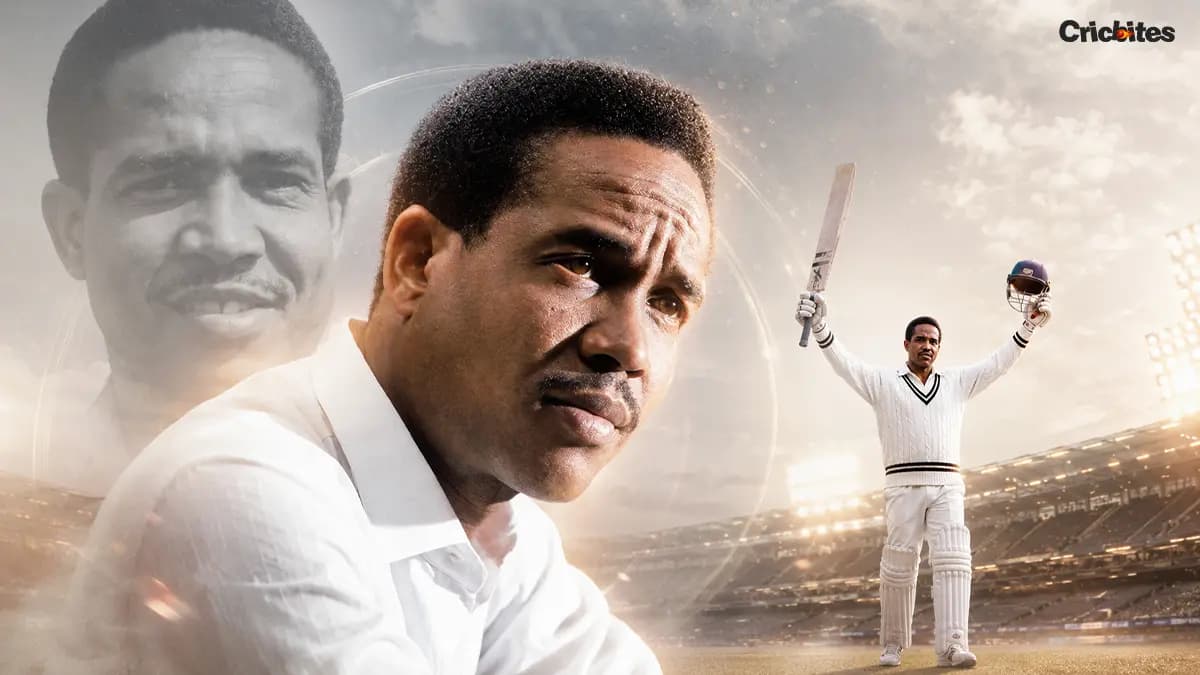
Sir Garfield St Aubrun Sobers, widely known as Sir Garfield Sobers, was a Barbadian cricketer who represented the West Indies from 1954 to 1974. An attacking batter, a bowler capable of delivering in different styles and an outstanding fielder, he is regarded by many as the greatest all-rounder in cricket history and one of the finest players the game has produced.
Sobers captained the West Indies for seven years from 1965 to 1972. He also holds the record for the fourth-highest individual score in Test cricket, making an unbeaten 365 against Pakistan when he was just 23 years old.
Sobers passed away on 17 July 2026 at the age of 89. After his death, Barbados Prime Minister Mia Mottley paid tribute to him in a eulogy and announced two national days of mourning.
Early Life
Garfield St Aubrun Sobers was born on 28 July 1936 by Caesarean section to Shamont and Thelma Sobers at Walcott Avenue, Bay Land, St Michael, Bridgetown, Barbados. He was the fifth of six children. He was born with two extra fingers, one on each hand, which he later removed himself as a boy using catgut and a sharp knife.
When Sobers was five years old, his father died at sea in January 1942 after the ship he was travelling on was torpedoed by a German U-boat. From a young age, Sobers showed natural talent and a love for almost every ball sport, especially cricket, football and basketball.
Along with his equally gifted brother Gerald, he helped Bay Street Boys’ School win the primary school Inter-School Cricket championship for three years in a row. At the age of 13, he joined two local cricket teams, Kent St Philip in the Barbados Cricket League (BCL) and Wanderers, based in Bay Land, in the Barbados Cricket Association (BCA).
Biography Details
| Field | Details |
|---|---|
| Full Name | Sir Garfield St Aubrun Sobers |
| Date of Birth | 28 July 1936 |
| Age | 89 years (at the time of his passing in 2026) |
| Date of Demise | 17 July 2026 |
| Birthplace | Bridgetown, Barbados |
| Nationality | Barbadian |
| Role | All-rounder |
| Batting Style | Left-handed |
| Bowling Style | Left-arm fast-medium |
| Domestic Teams | Barbados, South Australia, Nottinghamshire |
| International Team | West Indies |
| Marital Status | Divorced (formerly married to Prudence “Pru” Kirby) |
Debut and ICC Career
Sobers made his first-class debut for Barbados in 31 January 1953 when he was 16 years old. On 30 March 1954, he played his first Test for the West Indies. He began his career mainly as a bowler before moving higher up the batting order.
Playing against Pakistan in 1958, Sobers scored his first Test hundred and turned it into an unbeaten 365, setting a new world record for the highest individual Test score. The record stood until Brian Lara made 375 in 1994.
In 1965, Sobers was appointed captain of the West Indies, a position he held until 1972. He also led the Rest of the World XI during its 1970 tour of England. Across 93 Test matches for the West Indies, Sobers scored 8,032 runs at an average of 57.78 and claimed 235 wickets at 34.03. Among players with more than 5,000 Test runs, he has the fifth-highest batting average.
Although Sobers is best remembered for his legendary Test career, he also featured in the early days of One Day International cricket. He played his only ODI for the West Indies against England in 5 September 1973, scoring 0 runs and taking 1 wicket.
During his first-class career, Sobers played 383 matches, scored more than 28,000 runs and took over 1,000 wickets. He also spent the later years of his career playing for South Australia and Nottinghamshire.
Latest News: West Indies Legend Sir Garfield Sobers Passes Away at 89, World Cricket Pays Tribute
Career Batting Stats (Left-Handed Batsman)
| Format | Span | Matches | Innings | Not Outs | Runs | Highest Score | Average | Balls Faced | Strike Rate | 100s | 50s | 4s | 6s |
|---|---|---|---|---|---|---|---|---|---|---|---|---|---|
| Test | 1954–74 | 93 | 160 | 21 | 8032 | 365* | 57.8 | – | – | 26 | 30 | – | – |
| ODI | 1973 | 1 | 1 | 1 | 0 | 0 | 0.0 | 6 | 0.0 | 0 | 0 | 0 | 0 |
| 1st Class | 1953–74 | 383 | 609 | 93 | 28314 | 365* | 54.9 | – | – | 86 | 121 | – | – |
| List A | 1963–74 | 95 | 92 | 21 | 2721 | 116* | 38.3 | – | – | 1 | 18 | – | – |
Career Bowling Stats (Left-Arm Fast Medium Bowler)
| Format | Span | Match | Inn | Balls Bowled | Mdn | Runs Given | W | Best Bowling | Eco | Avg | SR | 4W | 5W |
|---|---|---|---|---|---|---|---|---|---|---|---|---|---|
| Test | 1954–74 | 93 | 159 | 21599 | 974 | 7999 | 235 | 6/73 | 2.22 | 34.0 | 91.9 | 8 | 6 |
| ODI | 1973 | 1 | 1 | 63 | 3 | 31 | 1 | 1/31 | 2.95 | 31.0 | 63.0 | 0 | 0 |
| 1st Class | 1953–74 | 383 | 640 | 70778 | 2894 | 28941 | 1043 | 9/49 | 2.45 | 27.8 | 67.9 | 44 | 36 |
| List A | 1963–74 | 95 | 91 | 4423 | 122 | 2426 | 109 | 5/43 | 3.29 | 22.3 | 40.6 | 4 | 1 |
Career Fielding Stats
| Format | Span | Catches | Run Outs | Stumpings |
|---|---|---|---|---|
| Test | 1954–74 | 109 | 0 | 0 |
| ODI | 1973 | 1 | 0 | 0 |
| 1st Class | 1953–74 | 405 | 3 | 0 |
| List A | 1963–74 | 41 | 0 | 0 |
Captaincy Career
Sobers enjoyed a winning start as West Indies captain after his side defeated Australia by 179 runs in the opening Test at Sabina Park. West Indies went on to win the series 2-1 and lifted the Frank Worrell Trophy. It was the first time the team had defeated Australia in a Test series.
The 1966 tour of England became one of the finest periods of Sobers’ career, earning him the nickname “King Cricket”. In five Tests, he scored 722 runs at an average of 103.14, including three centuries. He also took 20 wickets at 27.25 and held 10 catches. West Indies won the series 3-1, with one Test ending in a draw. His achievements were later celebrated by Trinidadian calypso singer Mighty Sparrow in the song “Sir Garfield Sobers”.
During the 1966-67 tour of India, Sobers led the West Indies to a 2-0 series victory, with one Test ending in a draw. His first series defeat as captain came in 1967-68 when England beat West Indies at home. Four Tests finished as draws, while England won the fourth Test at Queen’s Park Oval after Sobers made a controversial declaration that left England needing 215 runs at four an over to secure victory.
Sobers then captained West Indies on the 1968-69 tour of Australia, where the team lost the series 3-1. They later travelled to New Zealand, where the three-Test series finished level at 1-1.
West Indies were beaten 2-0 in England in 1969, with one Test ending in a draw. Sobers remained captain for the five-Test home series against India in 1970-71. India won the series 1-0, while the other four matches were drawn. A year later, he led West Indies in a five-Test home series against New Zealand, with all five matches finishing as draws.
Rohan Kanhai replaced Sobers as West Indies captain for the 1972-73 home series against Australia. Sobers missed that series but returned to the side under Kanhai for the 1973 tour of England. He played the final Test of his career in March 1974 against England at Queen’s Park Oval in Port of Spain.
Further Reading: Kohli-Rohit Reach Historic 400-Match Milestone Together in ODIs
Playing Style & Strengths
Sobers batted and bowled left-handed. His all-round ability allowed him to bowl every type of left-arm bowling, from spin to fast-medium pace. In the field, he was often positioned close to the batter, although he was equally dependable in the outfield.
He started his bowling career as a left-arm orthodox spinner before adding left-arm wrist spin and googlies to his game. Sobers could also bowl as a seamer, using medium pace when needed, but he was at his best bowling fast. With the new ball, he had the ability to produce late swing at high speed, using a smooth run-up followed by a quick whipping action.
Records and Achievements
In 1968, Sobers became the first cricketer to hit six sixes in a single over in first-class cricket, a feat that is still remembered as one of the game’s most famous moments. In recognition of his contribution to cricket, Sobers was knighted, named among Wisden’s Cricketers of the Century and later inducted into the ICC Hall of Fame. These honours reflected the enormous impact he made on the sport.
Even before receiving a knighthood in 1975 or being named a National Hero of Barbados in 1998, Sobers had already earned worldwide recognition. He captained the West Indies for seven years from 1965 and enjoyed a remarkable 1966 tour of England, where he was known as “King Cricket” after averaging more than 100 in a series victory.
Personal Life
Sobers married Australian Prudence “Pru” Kirby in September 1969. They had two sons and an adopted daughter. The couple separated in 1984 before their marriage ended in divorce in 1990. Through his marriage, Sobers became a dual Australian citizen in 1980.
Golf was Sobers’ favourite sport away from cricket. He also wrote a children’s cricket novel, Bonaventure and the Flashing Blade, which was published in 1967. Sobers passed away on 17 July 2026 at the age of 89.
Conclusion
Born in Barbados, Sobers is widely recognised as one of the greatest players in cricket history. He represented the West Indies for 20 years, making his Test debut in 1954 and playing his final Test in 1974, with both matches coming against England. The ICC’s award for the leading men’s cricketer of the year is named the Sir Garfield Sobers Trophy in his honour.
Sir Garfield Sobers was far more than just the game’s greatest all-rounder. He was one of cricket’s finest players, played a major role in shaping the West Indies during one of the team’s greatest periods and left a lasting legacy that will remain part of the sport’s history.
Read Next: BCB Confident of Hosting India in September, Awaits Better Broadcast Deal
FAQs: People Also Ask
Q1. When was Sir Garfield Sobers born?
Sir Garfield Sobers was born on 28 July 1936.
Q2. Where was Sir Garfield Sobers born?
Sir Garfield Sobers was born in Bridgetown, Barbados.
Q3. When did Sir Garfield Sobers make his Test debut?
Sir Garfield Sobers made his Test debut on 30 March 1954.
Q4. When did Sir Garfield Sobers make his ODI debut?
Sir Garfield Sobers made his ODI debut on 5 September 1973.
Q5. When did Sir Garfield Sobers passed away?
Sir Garfield Sobers died on 17 July 2026 at the age of 89.