

Loading…

Why Does the Pink Ball Swing More Than Red Ball? Science Behind It
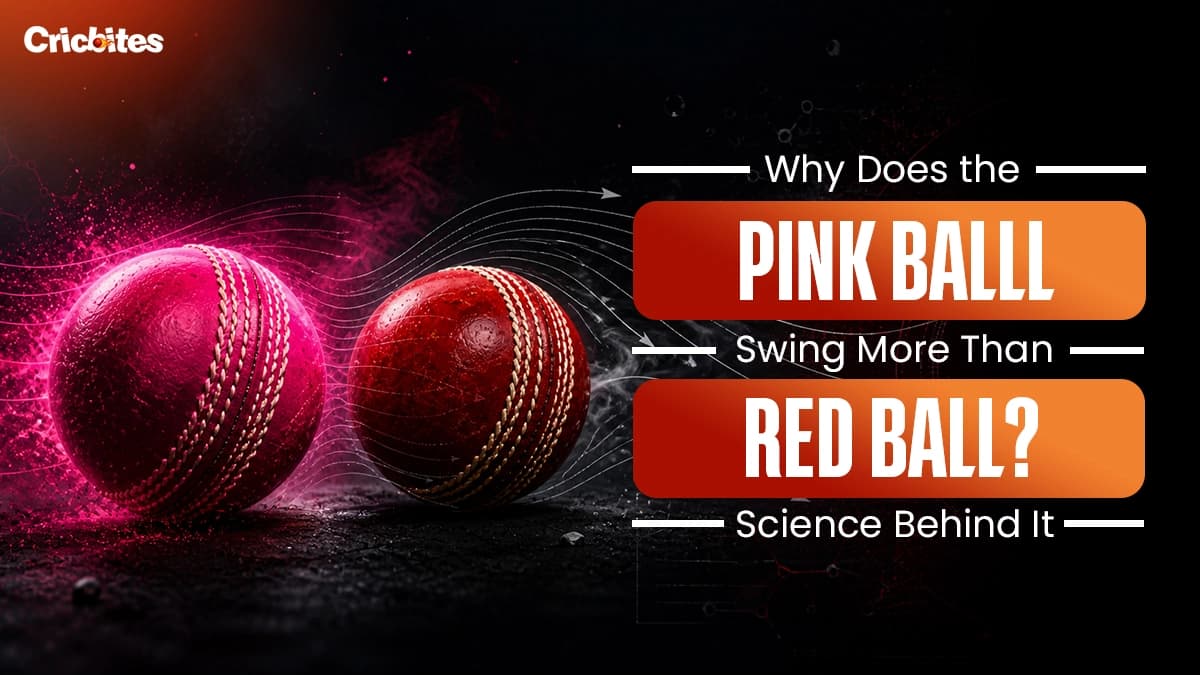
The pink cricket ball is not just a colour upgrade. It is transforming cricket into a completely different mindset. Same game, same rules, but the behaviour changes. Bowlers know it, batsmen feel it, and the conditions dictate it. The key difference starts with the surface.
The pink ball has an extra lacquer that makes it visible under floodlights and durable for day-night Tests. That coating is not decoration. It changes how the ball moves in the air, and it changes the game. The concept went mainstream after the first official day-night Test at Adelaide in 2015, when international cricket seriously tested the pink ball under lights.
Surface and Construction Impact
The pink ball often swings more than the red ball, especially in the early overs and in the evening. This is not just opinion. Match patterns in day-night Tests show a significant increase in pace in the early stages of play under lights compared to traditional red-ball sessions. The reason for this is simple physics. The lacquer keeps the surface smooth on one side for longer.
This means that one side remains shiny while the other starts to wear down. When that difference increases, the air flows unevenly around the ball. The result is swing. Not magic. Just a controlled imbalance in the airflow. In many day-night Tests since 2015, commentators and analysts have noted a sharp swing window in the first 20 overs.
Early Movement and Swing Phase
When the ball is new, it moves with less resistance in the air. The surface is hard and polished, so the air doesn’t grip it evenly. Studies and match analysis of day-night Tests have repeatedly shown that most of the swing effect occurs under lights in the early overs, especially before the glare has subsided.
One side creates a little more drag than the other, and the ball starts to swing sideways. Bowlers use this phase to attack early because it also becomes difficult for batsmen to make decisions under the lights. This is why wickets often fall in clusters during the first session of a pink-ball Test.
Hardness and Durability Factor
Hardness is another factor. The pink ball is designed to stay hard for a long time. It helps keep the seam straight and stable. Compared to the red ball, which softens gradually over a long period of time, the pink ball maintains a strong structure throughout its early life cycle.
The stable seam gives bowlers better control and keeps the swing active for more overs in the early and middle stages. Simply put, the ball does not break as quickly, so its movement remains effective for a longer period than expected. Several test observations show that the pink ball mainly maintains its hardness advantage in the first 30-40 overs.
Twilight and Weather Influence
Then comes the twilight effect. This is where things calm down. As the daylight hours decrease and the floodlights increase, the air becomes cooler and often more humid. This change affects the speed of the ball.
Since the day-night Test format was introduced in 2015, data has shown that many matches are more likely to see more wickets fall in the evening sessions than during the day. This is why many games see a sudden change in pace during this phase, almost as if the match has been reset under the lights.
Related Post: Types of Balls in Cricket: What’s The Difference? (2025)
Visibility and Batter Perception
Visibility also plays a role. Under floodlights, the pink ball can be difficult to pick up cleanly, especially at dusk. Studies on visual tracking in cricket suggest that visual delay increases in changing light conditions, especially during the twilight transition.
Batsmen don’t just deal with movement. They deal with delayed recognition of that movement. Even small deviations in the air seem larger because tracking is a little more difficult. This is one reason why early criticism of the pink ball focused on visibility during the dusk phase.
Comparison with Red Ball
Now compare this to a red ball. A red ball is more predictable in its behavior. It starts with a swing, then gradually loses its luster, then settles into a slow motion, and then can reverse swing as it gets old and rough.
It follows a long pattern shaped by wear and tear and maintenance. It is built to last through long innings and multiple sessions, where conditions change slowly and patterns form over time.
Read Next: IPL Cricket Ball Price 2026: Features, Cost & Details
Difference in Match Behaviour
The pink ball does not follow a uniform long rhythm. Its lacquered surface wears differently. The initial swing is often stronger, especially under lights, but the consistency decreases rapidly compared to the long wear cycle of the red ball.
Match observations from day-night tests suggest that the most effective swing phase is concentrated in a short window rather than spread evenly over the innings. This creates intense phases in the game, where the pace changes quickly and unpredictably.
Conclusion
Cricket is no longer just about skill. It is also about timing, conditions and adaptation. The pink ball adds an extra layer of unpredictability. It swings more in the early overs, reacts more strongly under the lights and changes behaviour more quickly than the traditional format.
Since its formal introduction to international Test cricket in 2015, it has consistently produced matches where the pace changes more in short bursts. That is why games feel more phased with it. One phase is for the bowlers, one is for the batsmen, and one is for the conditions. The red ball rewards patience and long-term planning.
The pink ball rewards quick reading of conditions. In the end, both test the same thing in different ways: who is better adjusted when the game stops being static and starts reacting to its environment.
Read More: How Are Cricket Pitches Prepared? The Full Step-by-Step Process
FAQs: Frequently Asked Questions
Q1. When did pink ball Test cricket start?
It started at Adelaide Oval in 2015, when cricket entered the night.
Q2. Why is twilight dangerous for batsmen?
Because the light changes, the ball moves slower, and the eyes react a split second too slowly.
Q3. Why do wickets fall faster in pink ball Tests?
Because the ball moves faster under the lights and mistakes happen more quickly than expected.
Q4. Is pink ball cricket difficult for batsmen?
Yes, because the ball doesn’t stay honest for long as dusk falls.
Q5. Why does pink ball cricket feel different?
Because matches change in waves, and conditions start to speak louder than the players.
Also Read: The Secret Behind Virat Kohli’s Water: How Much Does It Really Cost?